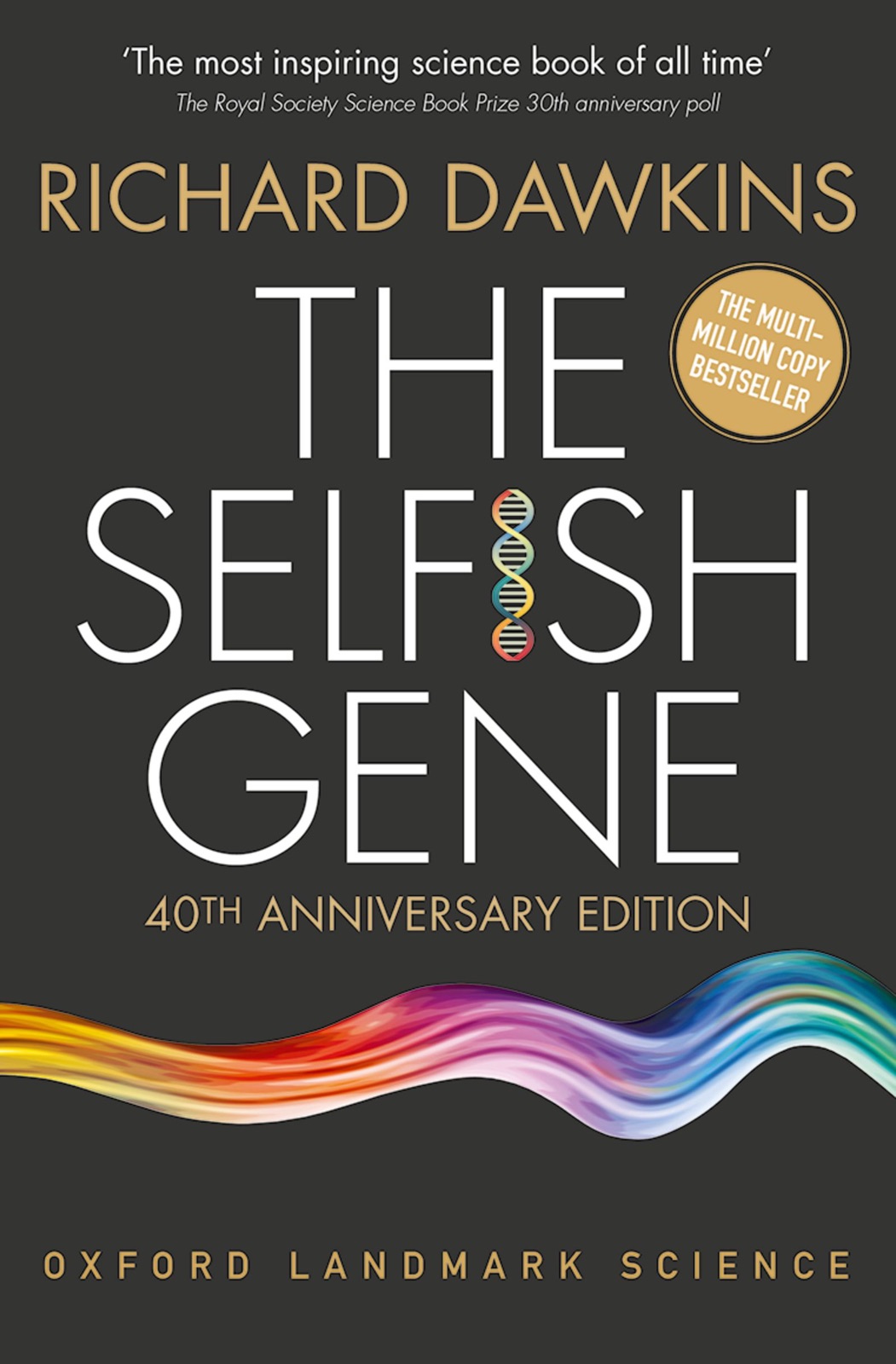
The Selfish Gene
The gene's-eye view of evolution that reshaped how a generation understands life itself.
Core ideas
Evolution is best understood from the gene's perspective; we are its survival machines.
Apparent altruism often makes sense as genes promoting copies of themselves.
Cooperation and selfishness both emerge from the same gene-level logic.
Dawkins coins the meme: ideas that replicate and evolve like genes.
Lessons from the book
The gene's point of view
You are a vehicle. The gene is the thing that persists.
Dawkins asks you to flip perspective. We usually think evolution works for the good of the individual or the species. He argues the real unit of selection is the gene, and that bodies are survival machines that genes build to carry themselves into the next generation. What endures across time is not you, but the information in your genes.
Once adopted, the view is startlingly clarifying. Traits persist because they helped copies of the responsible genes survive, not because they helped the animal be happy or the species thrive. It is not a claim that genes have intentions. It is a lens: ask what would make this gene more common, and puzzling behaviour snaps into focus.
Why selfish genes build kindness
Genes for helping relatives spread, because relatives carry the same genes.
The paradox in the title is that selfish genes routinely produce generous animals. The resolution is that a gene promoting help for close kin is often helping copies of itself sitting in those relatives. A mother risking herself for her children, a bee dying for its hive: cooperation as gene-level arithmetic.
Dawkins walks through the maths of kin selection and reciprocal exchange to show that altruism and selfishness are not opposites but outputs of the same logic under different conditions. It reframes some of biology's hardest puzzles, and it also warns against the naturalistic fallacy: understanding the gene's ruthlessness is a reason to teach generosity, not to excuse cruelty.
Memes, the second replicator
Ideas copy, mutate, and compete for survival, just like genes.
In the final chapter, almost as an aside, Dawkins coins a word that escaped the book and colonised the culture: meme. A meme is a unit of cultural transmission, a tune, a slogan, a belief, that spreads from mind to mind by imitation, and is subject to the same evolutionary pressures as a gene.
His point is that Darwinian logic is not confined to DNA. Anything that copies itself with variation and differential survival will evolve, and ideas qualify. Successful memes are not necessarily true or good, only good at spreading, which is an uncomfortable and prescient thought to have published decades before the internet proved it daily.
Our take
This is the book that taught a whole generation to see evolution from the gene's point of view, and once it clicks, a lot of biology suddenly makes sense, including why animals are sometimes ruthlessly selfish and sometimes astonishingly cooperative. It's a genuine paradigm shift, not just a tidy popularisation.
Dawkins is a sharp writer, but it's a demanding read, and the title misleads people: selfish describes the genes, not a recommendation for how you should live. He also coins the word meme here, almost in passing. Bring some appetite for rigour and it rewards you; come looking for a gentle introduction and you may struggle.
Is it for you?
Read it if
Readers ready for a rigorous, paradigm-shifting account of natural selection.
Skip it if
Those wanting a gentle intro , it rewards patience and some scientific appetite.