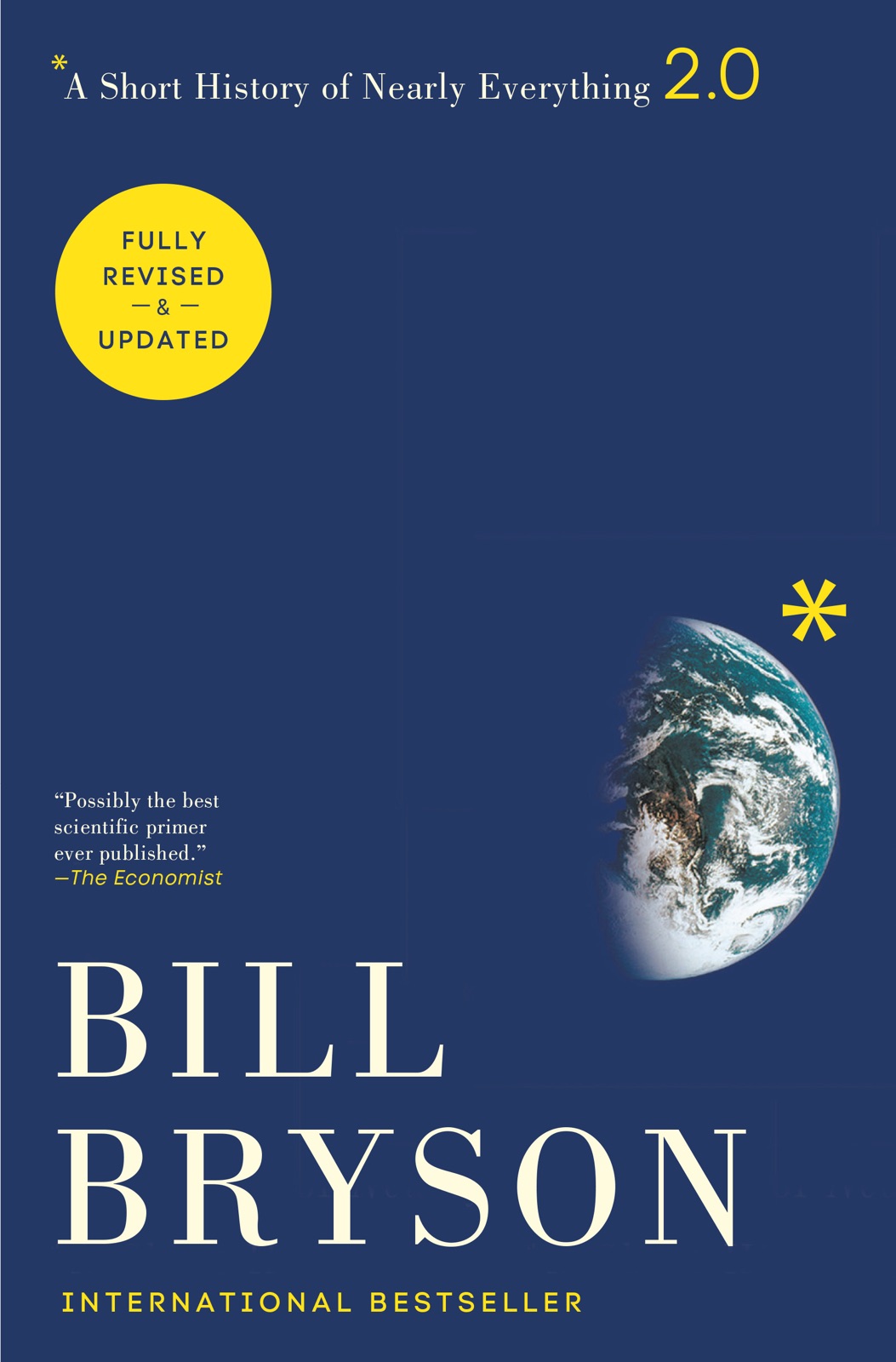
A Short History of Nearly Everything
A witty, wonder-filled tour of how we came to know what we know about the universe and life.
Core ideas
From the Big Bang to DNA, science is a human story full of accident, rivalry, and luck.
The scale of space and deep time is almost impossible, and thrilling, to grasp.
Your existence depends on an unbroken chain of improbable events.
How we know is as fascinating as what we know.
Lessons from the book
How we know what we know
The facts are less interesting than the messy, human way we dug them up.
Bryson's move is to make discovery the story, not the discoveries. How does anyone weigh the Earth, or measure the distance to a star, or know what the core is made of when nobody has been near it? Each chapter is a small detective tale about ingenuity, guesswork, and instruments cobbled together.
Told this way, science stops being a wall of settled facts and becomes a human activity full of dead ends and inspired hunches. It is a more honest picture and a more inviting one. You come away trusting the results more, precisely because you have seen how hard-won and self-correcting the process that produced them really is.
Scientists are gloriously human
Behind the tidy textbook names sit feuds, blunders, and wild eccentrics.
Bryson delights in the people. Newton sticking a needle in his own eye socket to study optics. Feuding paleontologists sabotaging each other's digs. The chemist who discovered oxygen but misread his own result. Isaac Newton was arguably a genius and undeniably strange, and the book never pretends otherwise.
The effect is to demystify genius without diminishing it. Discoveries were made by real, flawed, often lucky people, which makes the achievements feel closer rather than more distant. It also quietly teaches how science self-corrects: even brilliant people got things wrong, and the method, not the individual, is what eventually sorted truth from error.
The improbability of you
An unbroken chain of luck across billions of years ends at your existence.
Bryson opens on the fact that you exist at all. Every one of your ancestors, back through humans, fish, and single cells, survived long enough to reproduce, an unbroken relay across nearly four billion years. Break the chain anywhere and you are not here. The odds against any particular person are effectively infinite.
He extends the wonder outward: the improbable stability of Earth's orbit, the freak of a large moon, the atoms in your body forged inside dying stars. The cumulative effect is not smallness but astonishment. Understanding the scale and the luck, he suggests, is its own kind of reverence, available to anyone who looks.
Our take
Bryson is a travel writer who got curious about science, and that outsider's sense of wonder is exactly what makes this so delightful. It's the book we wish we'd been handed in school: the same physics and biology, but told as a very human story full of feuds, blunders, and sheer dumb luck.
It won't turn you into an expert, and a few details have dated since 2003, but that was never the point. The point is to come away genuinely awed that you exist at all, and that anyone pieced together how any of this works. If science ever bored you senseless, start right here and let it surprise you.
Is it for you?
Read it if
Anyone who found school science dull and wants the awe restored.
Skip it if
Specialists wanting current, technical depth rather than a sweeping survey.