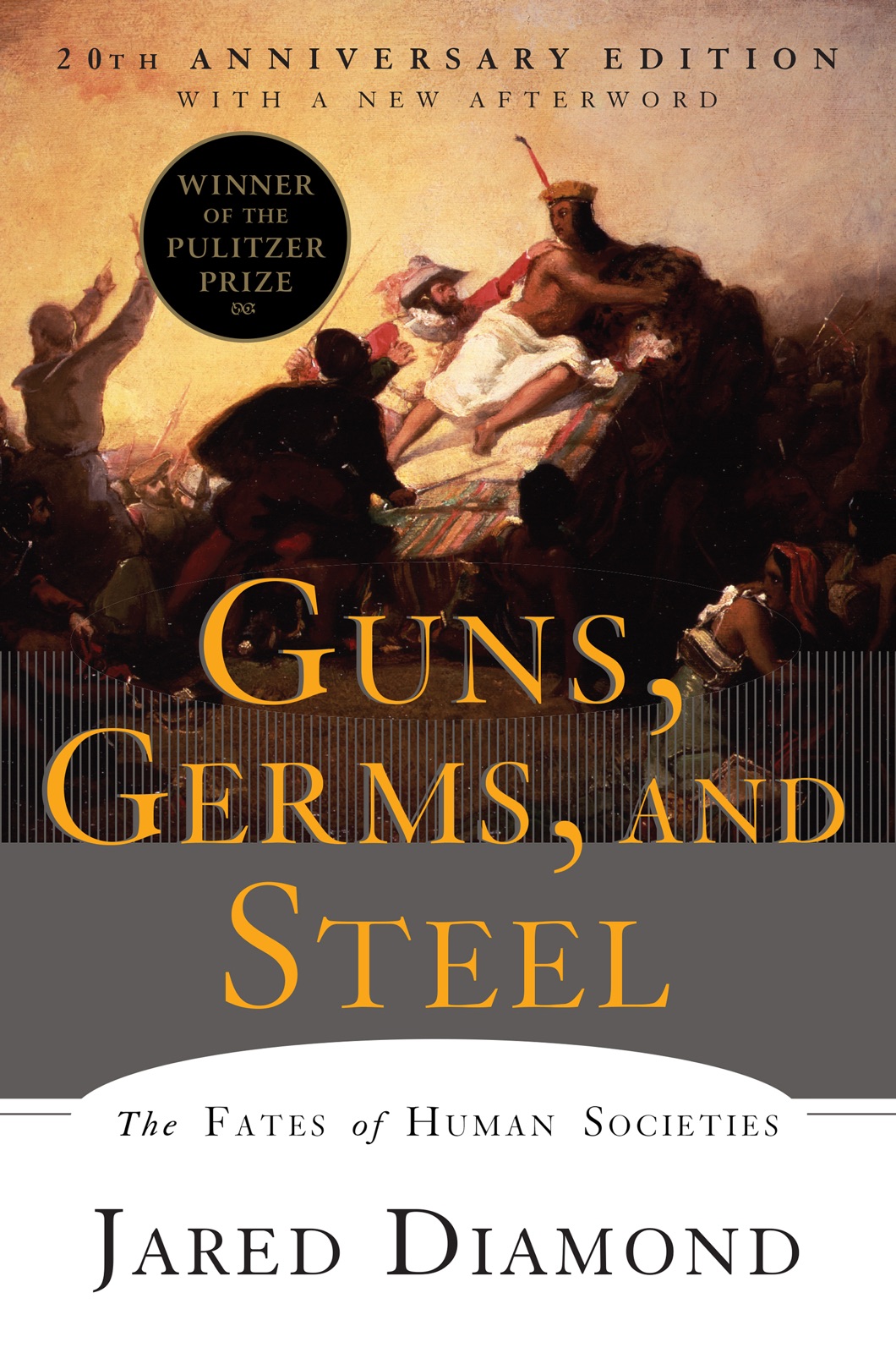
Guns, Germs, and Steel
The Fates of Human Societies
Argues that geography, not race or culture, explains why history unfolded so unequally.
Core ideas
Continental differences in crops and animals, not innate ability, drove who developed what.
Eurasia's east-west axis let farming and technology spread quickly along similar climates.
Dense farming societies bred the epidemic diseases that later devastated other peoples.
Big-picture environmental causes underlie what looks like cultural superiority.
Lessons from the book
Yali's question
Why did history hand such unequal cargo to different peoples?
A New Guinean politician named Yali asked Diamond why Europeans had so much cargo, so much wealth and technology, while his own people had so little. Diamond spends the book answering without reaching for the toxic old explanation of innate difference. The question is the moral engine of the whole project.
His answer starts by clearing the ground: there is no evidence that any population is inherently smarter or more capable. So the causes of vast inequality must lie outside biology, in the environments different peoples happened to start from. Reframing a loaded question as a geographic one is itself the book's first achievement.
Lucky latitudes
Some places were simply dealt better plants, better animals, and a better-shaped map.
Diamond argues the head start came from geography. The Fertile Crescent had the richest set of domesticable plants and large animals on Earth; most of the world's candidate species could never be tamed. Farming produced food surpluses, which produced dense populations, specialists, writing, and eventually steel.
The map's orientation mattered too. Eurasia runs east to west along shared climates, so crops and inventions spread quickly across it. The Americas and Africa run north to south across climate bands, so the same spread crawled. None of this is about the people. It is about the hand the continents dealt them.
Guns, germs, and steel
The deadliest weapon Europeans carried was invisible.
When Pizarro's tiny band toppled the Inca, steel and horses helped, but the real destroyer arrived earlier and unseen: disease. Life packed together with domesticated animals had bred smallpox, measles, and flu, and centuries of exposure had left Europeans partly resistant. Peoples without that history had no defence.
Epidemics ran ahead of the conquerors and emptied whole societies before armies arrived. Diamond's chain, farming to density to animals to germs, ends in one of history's grimmest accidents: the winners often won not by superiority but by carrying plagues they had survived and others had not.
Our take
Diamond asks an enormous, uncomfortable question, why did some peoples end up conquering others rather than the reverse, and answers it with geography and biology instead of any notion of innate superiority. That reframing mattered when it landed and is still worth understanding today.
Be ready for a dense, sometimes repetitive read, and know that historians have argued hard with his geographic determinism since. We think the value is in the central argument rather than every supporting detail: it's a powerful counter to lazy explanations of history, even where it overreaches. Skim the parts that drag; the thesis is the prize.
Is it for you?
Read it if
Readers who want a rigorous, ambitious theory of the broad sweep of history.
Skip it if
Those wanting a fast read , it's dense, and its determinism is much debated.