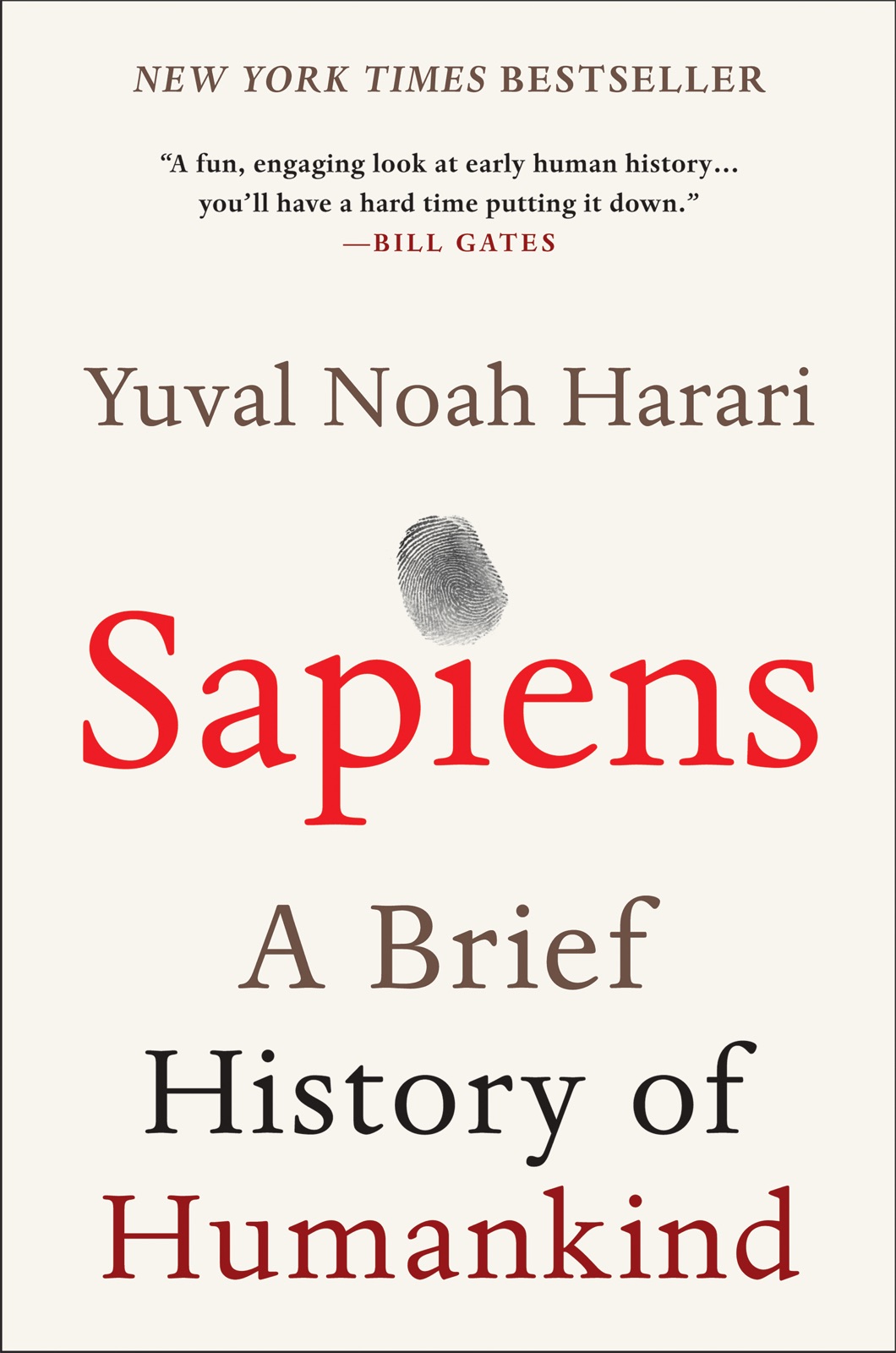
Sapiens
A Brief History of Humankind
A provocative single-volume story of how an unremarkable ape came to rule the planet.
Core ideas
Shared fictions, money, nations, religions, rights, let strangers cooperate at scale.
The Cognitive Revolution gave us imagination; the Agricultural Revolution may have been history's biggest fraud.
Empires, money, and universal religions stitched humanity into one global system.
We are more powerful than ever, yet not obviously happier, a question worth sitting with.
Lessons from the book
Fictions that bind strangers
Money, nations, and companies are stories, and the stories are why we cooperate.
Harari's central claim is that humans dominate the planet because we cooperate flexibly in huge numbers, and we do that on the strength of shared fictions. Money has value only because everyone agrees it does. Nations, corporations, laws, and human rights exist in the collective imagination, and yet they move armies and build cities.
Calling them fictions is not an insult. They are the most important inventions we have, because they let millions of strangers who will never meet act as one. Chimpanzees cooperate only in small troops built on personal acquaintance. Once you see money and nationhood as shared stories, a lot of history reads differently.
History's biggest fraud
We did not domesticate wheat. Wheat domesticated us.
The conventional story says agriculture was progress. Harari flips it: the Agricultural Revolution may have improved the species' survival while making individual lives worse. Foragers ate varied diets and worked fewer hours; early farmers ground out long days on a narrow diet, backs bent to crops, more vulnerable to famine and disease.
His provocation is that wheat used us as much as we used it, spreading across the planet on human labour. The species multiplied, but multiplication is not happiness. It is a useful corrective to the assumption that every technological leap makes life better for the people living through it. The count went up; the days got harder.
More powerful, no happier
We reshaped the world and never checked whether it made us content.
Harari closes the human story with an uncomfortable question. Across all our revolutions, cognitive, agricultural, scientific, we gained staggering power. But the evidence that we are happier than foragers is thin. Our comforts are real; so are our anxieties, and contentment has a way of resetting to a baseline whatever we achieve.
He does not answer it, and that restraint is the point. A book that could have ended in triumph ends in a question about whether we know what we want. For all our mastery of the external world, we have made little progress on the internal one. It is the note that lingers longest after the sweep of history fades.
Our take
Few books are better at making the ground shift under your feet. Harari's big idea, that shared fictions like money, nations, and human rights are what let millions of strangers cooperate, is the kind of reframe that quietly changes how you read the news for years afterward.
It's sweeping and supremely confident, sometimes too confident: specialists push back on plenty of his bolder claims, and you're best off reading it as a provocative interpretation rather than settled fact. Taken in that spirit it's exhilarating, and a genuinely great on-ramp to thinking at the scale of our whole species.
Is it for you?
Read it if
Curious generalists who want a sweeping, idea-dense overview of the human story.
Skip it if
Specialists who'll bristle at bold generalisations and contested claims.