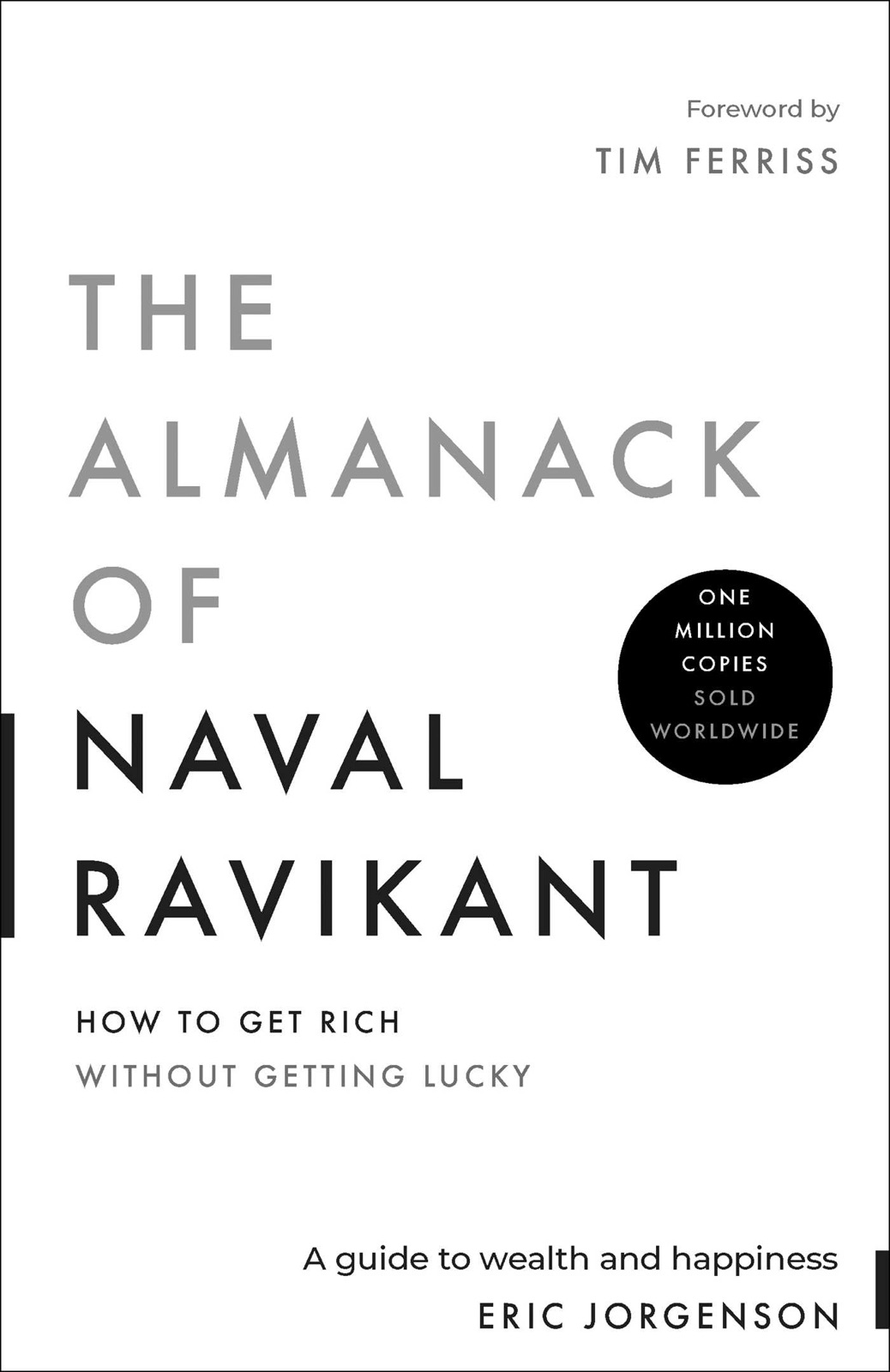
The Almanack of Naval Ravikant
A Guide to Wealth and Happiness
A curated collection of one founder-investor's principles on building wealth and a peaceful mind.
Core ideas
Seek wealth, not money or status: wealth is assets that earn while you sleep.
Play long-term games with long-term people; compounding rules trust and capital alike.
Specific knowledge, what feels like play to you, can't be trained or outsourced.
Happiness is a skill and a choice: a default state you can cultivate by subtracting wants.
Lessons from the book
Seek wealth, not money or status
Wealth is assets that earn while you sleep. Status is a zero-sum game.
Naval draws sharp lines between three things people blur. Money is how we transfer wealth. Wealth is assets that keep earning without your time: businesses, equity, code, media. Status is your ranking in a social hierarchy, and it is zero-sum, which is why status games turn people bitter and combative.
The advice that follows is to build or buy equity in something that scales without your hours, and to avoid renting out your time for a wage as the only strategy. Chasing status, by contrast, means someone must lose for you to win. Play the wealth game, which is positive-sum, and quietly step out of the status one.
Specific knowledge and leverage
Find what feels like play to you but looks like work to others, then multiply it.
Specific knowledge is the expertise you cannot be trained for in a classroom, the thing you are drawn to so naturally it feels like play while others find it tedious. It is highly personal, often at the edge of your obsessions, and precisely because it cannot be taught, it cannot easily be outsourced or automated.
Then apply leverage. Old leverage was labour and capital, which need permission. New leverage is code and media, which do not: products and content work for you while you sleep, at zero marginal cost, for millions. Naval's formula for outsized outcomes is specific knowledge plus accountability plus leverage, and the leverage is what makes it scale.
Happiness is a skill
Peace is what is left when you stop adding desires.
Naval treats happiness not as something to acquire but as a default state revealed when you subtract. Every desire, he says, is a contract you make with yourself to be unhappy until it is fulfilled. Choose your few desires deliberately, and drop the ambient ones, and a baseline contentment surfaces on its own.
He frames it as trainable, like fitness: through attention, habit, and the deliberate quieting of wants, present-moment peace becomes more available. It pairs naturally with the Stoics and with meditation. The surprising claim, from a man who got rich, is that the internal game matters more than the external one, and is more winnable.
Our take
This is less a book than a beautifully organised collection of one person's best thinking on wealth and happiness, assembled from Naval's tweets, podcasts, and talks. It's dense with quotable lines, and it's free as an ebook, which makes it an easy one to recommend to almost anyone.
Because it's aphorisms rather than sustained argument, you get compression and provocation but not much nuance; it tells you to seek wealth, not money or status, without always showing the working. We treat it as a thinking prompt: read a page, then sit with it. Great for dipping into; less satisfying if you want a built-out case.
Is it for you?
Read it if
Readers who like dense, quotable principles on leverage, wealth, and contentment.
Skip it if
Those wanting a structured argument rather than aphorisms drawn from tweets and talks.