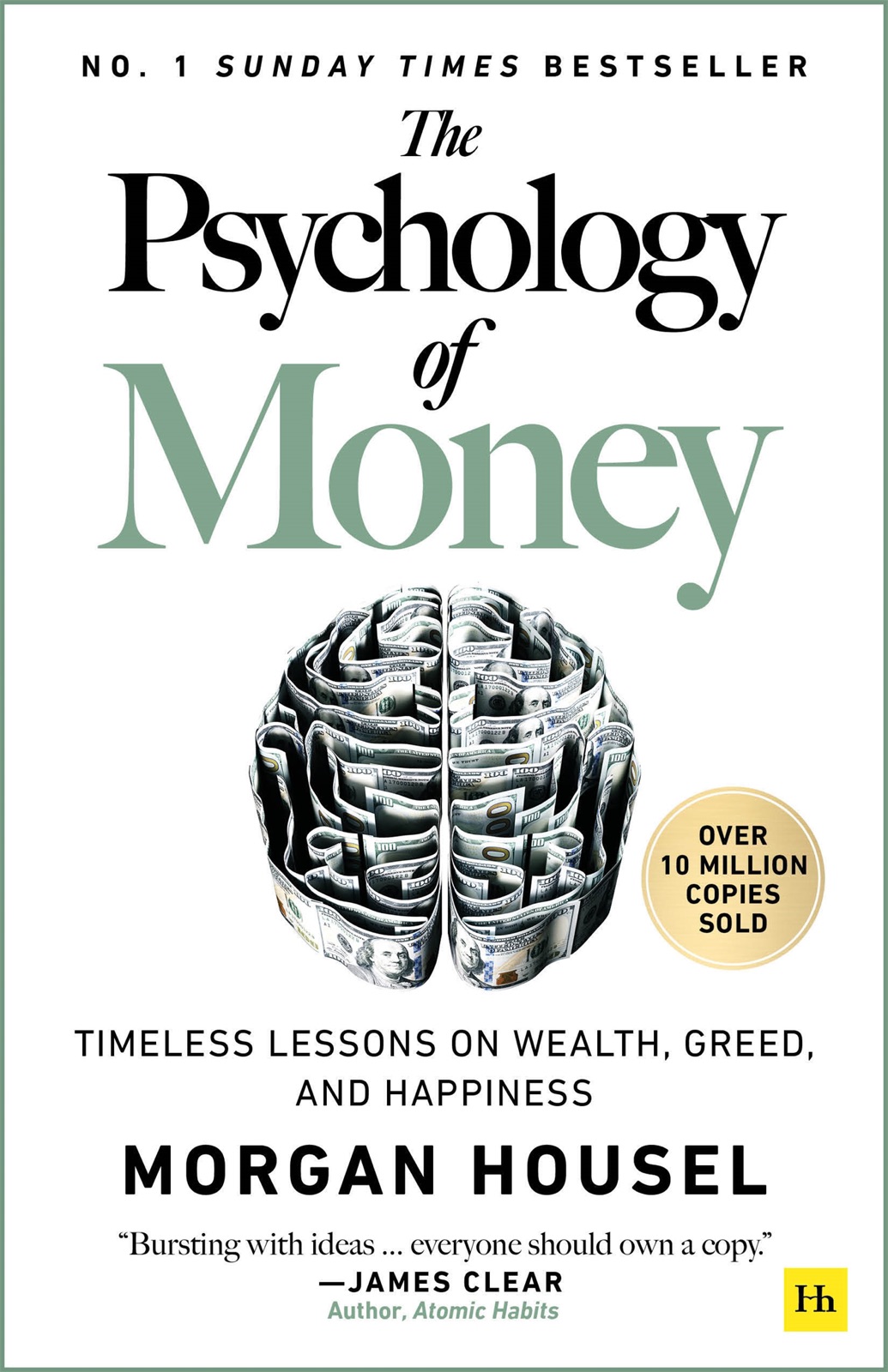
The Psychology of Money
Timeless Lessons on Wealth, Greed, and Happiness
Wealth is the result of behaviour, not intelligence, and behaviour is teachable.
Core ideas
Doing well with money has little to do with how smart you are and a lot to do with how you behave.
Reasonable beats rational. A plan you can stick with through fear and greed wins.
Saving is the gap between ego and income; you can build wealth without a high income.
Room for error, the margin of safety, is the only reliable way to survive an unpredictable world.
Lessons from the book
Nobody is crazy with money
Everyone's money decisions make sense to the person making them.
Housel opens with a disarming idea: your personal history with money, what your parents earned, which markets crashed in your twenties, shapes your financial instincts more than any textbook. Someone who grew up in high inflation trusts cash differently from someone raised inside a long bull market. Neither is stupid. Both are reasoning from different worlds.
The practical upshot is humility. Your intuitions are a sample size of one, drawn from a couple of decades of adult experience in one country. Before copying anyone's strategy or mocking anyone's caution, ask what world trained them. And before trusting your own gut, ask what world trained you.
Reasonable beats rational
The best plan is the one you can hold onto while frightened.
A spreadsheet can prove that stocks outperform cash over thirty years. The spreadsheet does not have to watch its balance drop forty percent and still send the kids to school. Housel's argument is that plans fail at the emotional layer, not the mathematical one, so a slightly suboptimal plan you can live with beats an optimal one you will abandon.
This is permission to build in comfort. Hold a little more cash than theory demands if it lets you sleep and stay invested. The goal is not to maximise returns on paper. It is to stay in the game long enough for compounding to do the work, and staying in is a psychological achievement.
Wealth is what you don't see
Spending is visible. Wealth is the money that never became a car.
We judge wealth by what people display: the car, the house, the holiday. But those are records of money spent, not money kept. Actual wealth is invisible, the investments and savings that never turned into objects. The person performing richness and the person becoming wealthy are often different people.
Housel pairs this with his sharpest line on saving: savings equal income minus ego. Past a point, spending is signalling, and the cheapest way to raise your savings rate is to want less audience. Freedom, the real luxury, is bought with the invisible money.
Our take
This is the rare money book we'd hand to someone who's sure they hate money books. Housel barely mentions spreadsheets. Instead he tells short, human stories, the janitor who quietly died a millionaire, the executive who went broke, and lets you draw the lesson yourself. It reads in an afternoon and then stays with you for years.
The line we keep coming back to is that reasonable beats rational. A mathematically perfect plan you abandon in a panic is worth less than a merely good plan you actually stick with. If money has ever made you feel a bit stupid, this book gently reframes the whole thing as a game of patience and temperament, things you can control, rather than raw intelligence.
Is it for you?
Read it if
Anyone who feels personal finance is presented as math when it's really about temperament and fear.
Skip it if
Readers wanting tactical, step-by-step instructions on budgeting or picking investments.