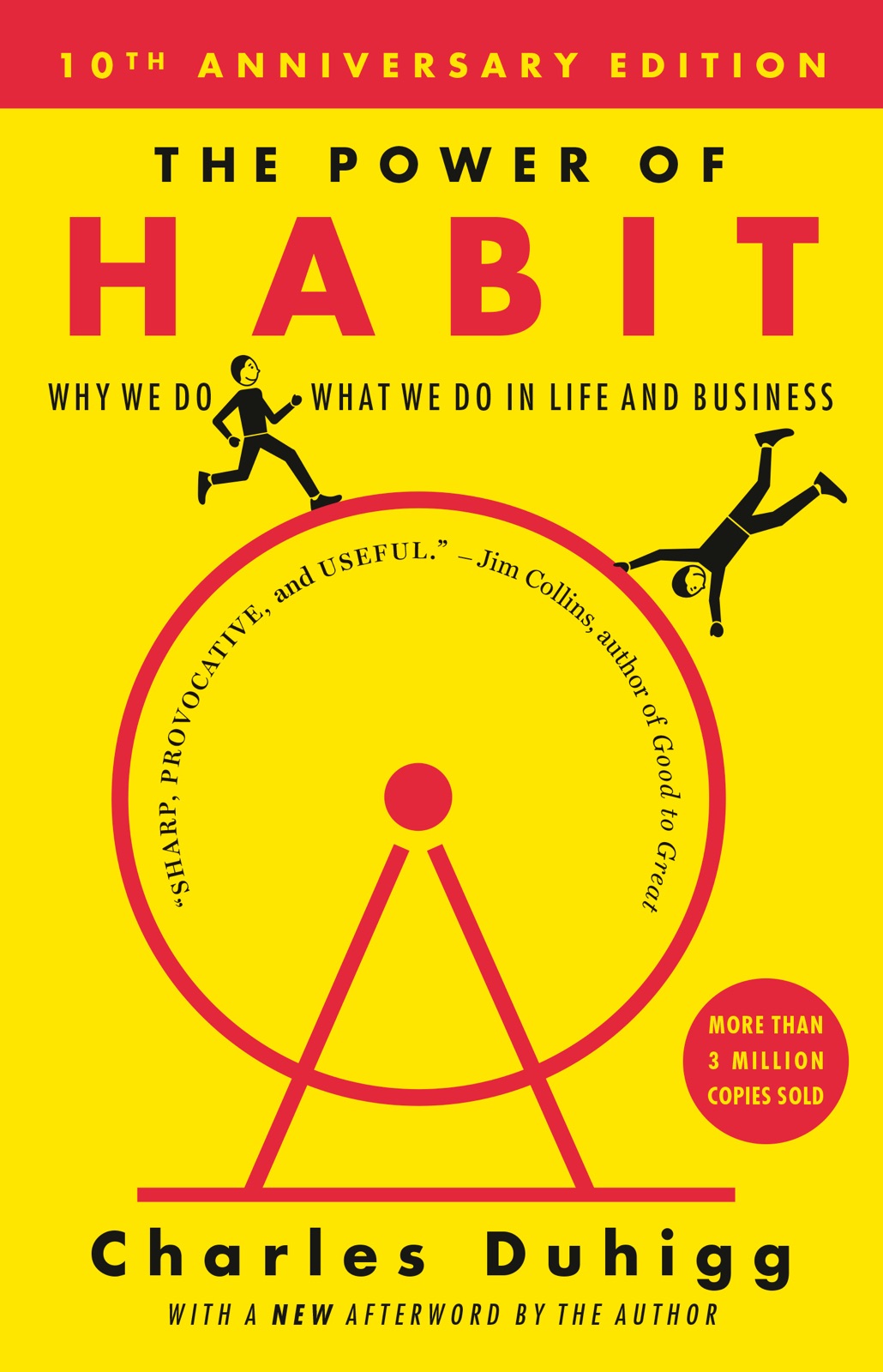
The Power of Habit
Why We Do What We Do in Life and Business
The narrative science of how habits form in the brain, and how they can be rewired.
Core ideas
Every habit runs on a loop: cue, routine, reward.
You can't erase a habit, but you can change the routine while keeping the cue and reward.
'Keystone habits' (like exercise) trigger cascades of other positive change.
Organisations and societies run on habits too, not just individuals.
Lessons from the book
The habit loop
Cue, routine, reward: the three-step circuit running under half your day.
Duhigg's foundation is the loop the brain builds around any repeated behaviour. A cue triggers the routine, the routine delivers a reward, and with repetition the sequence moves into the basal ganglia, running below conscious thought. Studies suggest around forty percent of daily actions are habits, not decisions.
The man with no memory who still walks to the kitchen proves the point: habit lives in older machinery than recollection. This is why resolutions fail against habits. You are not arguing with a belief, you are competing with a circuit, and circuits respond to engineering rather than intention.
The golden rule of habit change
Keep the cue, keep the reward, and swap only the routine between them.
You cannot delete a habit loop, but you can re-plumb its middle. Keep the same cue and deliver the same reward while inserting a new routine. Alcoholics Anonymous works partly this way: the cues for drinking remain, but meetings and a sponsor replace the bar while still delivering relief and companionship.
The craft is diagnosis. Duhigg's method is to experiment: when the urge hits, vary the reward and see what actually satisfies it. The afternoon cookie often turns out to be a walk, a chat, or simple boredom relief in disguise. Once you know what the loop is really paying you, substitution gets much easier.
Keystone habits
Some habits start chain reactions that remake everything around them.
When Paul O'Neill took over Alcoa, he talked only about worker safety, and investors thought he had lost his mind. But safety forced communication, measurement, and accountability through the whole company, and profits followed. Duhigg calls habits like this keystones: small wins that cascade.
Individuals have them too. Exercise reliably drags better eating, sleeping, and spending along behind it. Family dinners and made beds correlate with outcomes far beyond the acts themselves. The practical advice is to stop reforming everything at once and find the one habit whose ripples reach furthest, then protect it.
Our take
If Atomic Habits is the how-to manual, this is the story behind the science. Duhigg is a journalist, so you absorb the cue-routine-reward loop through gripping narratives, a toothpaste ad campaign, an aluminium plant, a man who lost his memory, rather than through bullet points and checklists.
We love it for readers who hold onto ideas best through stories. It's lighter on practical steps than Clear's book, which is why the two pair so well: read this for the why it works, then Atomic Habits for the what to do tonight. The keystone-habit idea, that some habits quietly drag others along with them, is the one we use most.
Is it for you?
Read it if
Readers who learn best through stories and case studies rather than checklists.
Skip it if
Those who want a step-by-step manual , pair it with Atomic Habits for the how-to.