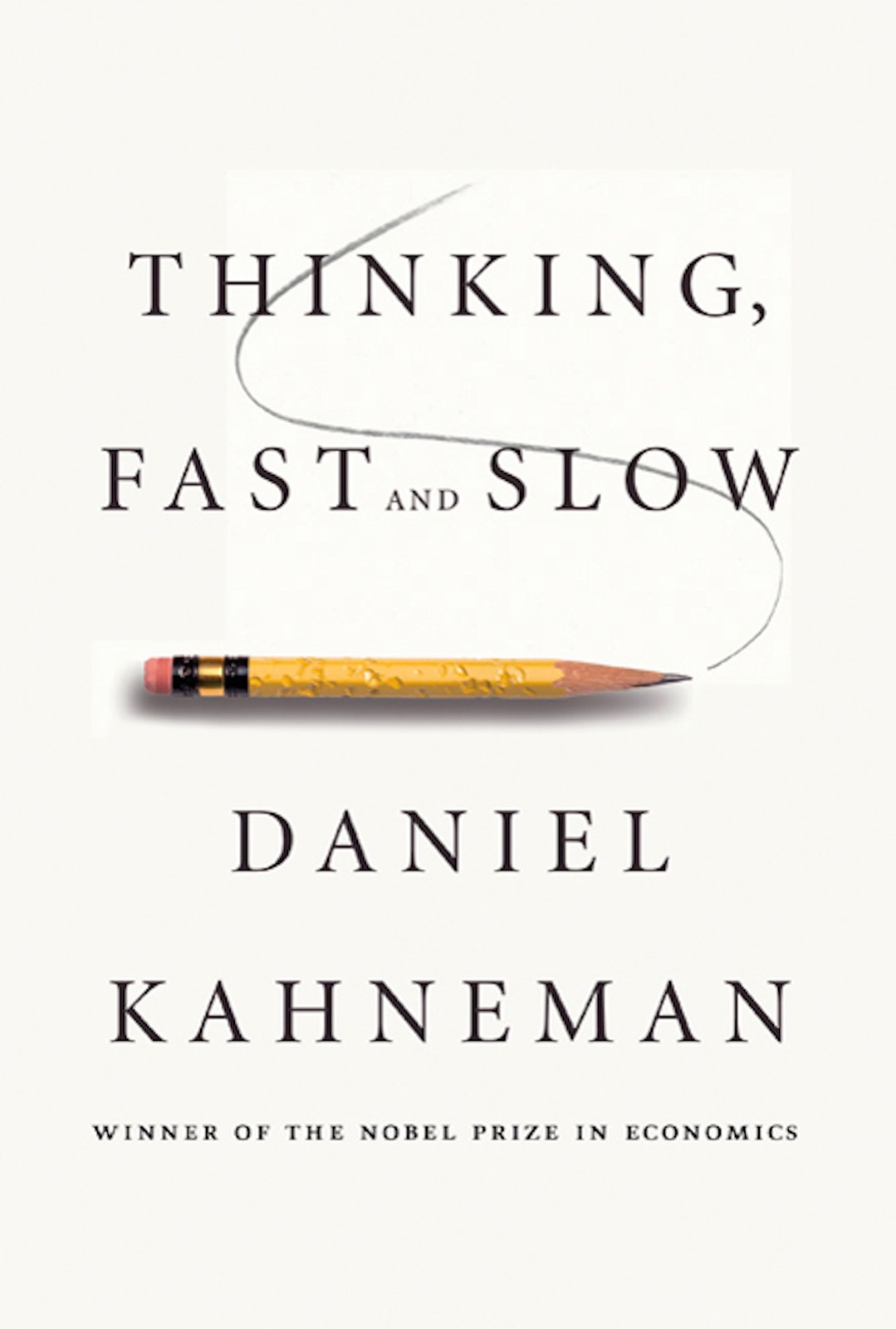
Thinking, Fast and Slow
A Nobel laureate's map of the two systems driving how we think, and where they reliably fail.
Core ideas
System 1 is fast, intuitive, emotional; System 2 is slow, deliberate, and lazy, and usually defers to System 1.
We're overconfident, anchored, and fooled by stories that feel coherent rather than true.
Losses loom larger than equivalent gains; how a choice is framed changes the decision.
Even experts substitute easy questions for hard ones without noticing.
Lessons from the book
Two systems, one driver
Fast intuition answers first; slow reason mostly rubber-stamps it.
System 1 is the automatic machinery: it reads faces, completes phrases, swerves the car, and produces instant impressions of everything. System 2 is the deliberate part that does algebra and weighs decisions, and it is lazy by design, since deliberate thought is metabolically expensive. Most of the time it accepts whatever System 1 hands over.
Kahneman's unsettling finding is that the handover is invisible. You experience your intuitions as reasoned conclusions. The book is a field guide to the seams: the moments when the fast answer is systematically wrong and only a deliberate, effortful check will catch it. Knowing where those moments are is the whole game.
Answering an easier question
When a question is hard, your mind quietly swaps it for one it can answer.
How happy are you with your life these days is a hard question. How is my mood right now is an easy one, and System 1 answers the easy one without telling you a swap occurred. Kahneman calls it substitution, and it runs everywhere: is this investment sound becomes do I like this company's story.
The swap explains why confident answers arrive faster than good ones. Fluency feels like truth. The defence is procedural rather than heroic: when the stakes are real, write the actual question down and check that the evidence you are weighing addresses it, not its easier cousin. Experts need this discipline most, because their intuitions arrive fastest.
Losses loom larger
Losing a hundred dollars hurts roughly twice as much as winning it pleases.
Prospect theory, the work behind the Nobel, starts from an asymmetry: we feel losses about twice as strongly as equivalent gains. From that one bend in the curve falls a cascade of behaviour, refusing good gambles, holding losing investments too long, and paying heavily for certainty and insurance.
The framing corollary is just as practical: the same choice reads differently as a loss or a gain. Ninety percent survival attracts; ten percent mortality frightens. Whoever writes the frame quietly steers the decision. Reframe important choices both ways before deciding, and notice when someone has done the framing for you.
Our take
This is a heavyweight in every sense: long, demanding, and written by a Nobel laureate summing up a whole career. It's not a beach read, but it's probably the single most influential book on the ways your own mind quietly fools you, and reading it slowly genuinely changes how you watch yourself think.
One fair warning: it predates psychology's replication crisis, and a few of the priming studies it cites haven't held up. The core framework, fast intuitive System 1, slow effortful System 2, and the predictable ways the first one tricks the second, is rock solid. We treat it as a reference to revisit, not a sprint to finish in a weekend.
Is it for you?
Read it if
Anyone who wants to understand the systematic biases behind human judgment.
Skip it if
Readers wanting a quick, breezy read , this is long, rigorous, and demands attention.