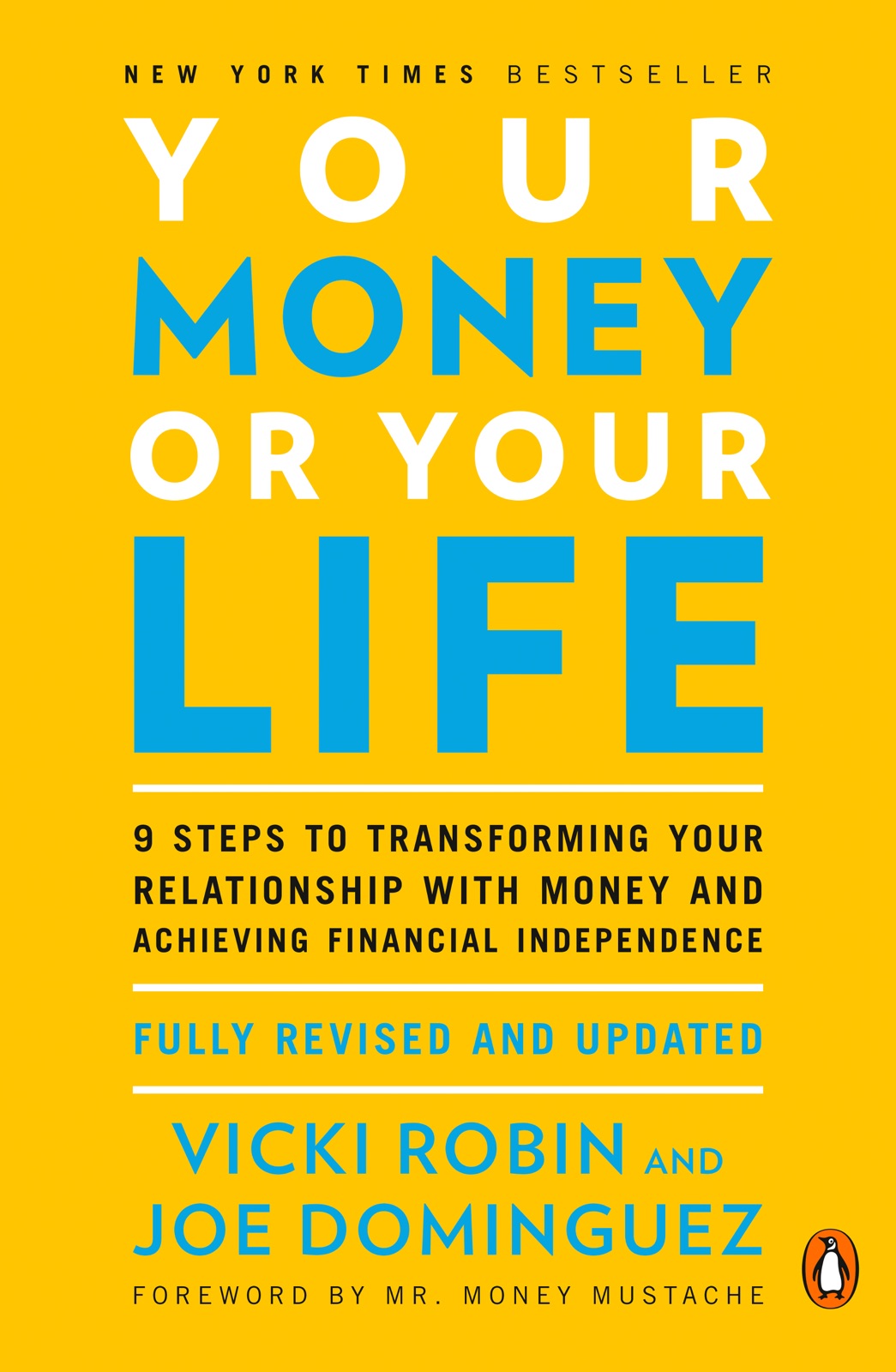
Your Money or Your Life
9 Steps to Transforming Your Relationship with Money
Reframes money as life energy: the hours of your life you trade for it.
Core ideas
Every purchase costs hours of your life; compute your real hourly wage to see the true price.
Track every dollar in and out. Awareness alone changes behaviour.
Enough is a real, findable number; beyond it, more money buys less happiness.
Financial independence is reached when investment income covers expenses.
Lessons from the book
Your real hourly wage
After the commute, the wardrobe, and the recovery time, what does an hour of you cost?
Take your pay, then subtract everything the job costs you: commuting, work clothes, decompressing, the takeout you buy because you are too tired to cook. Divide what is left by all the hours the job actually consumes, including the invisible ones. The result is usually far lower than your official rate.
That number is your exchange rate between life and money. A two hundred dollar jacket priced at your real wage might cost twenty hours of you. The question stops being can I afford it and becomes is it worth that much of my life. Different question, different answers.
Enough has a shape
The fulfilment curve rises, peaks, and then quietly falls.
Spending buys survival, then comfort, then some genuine luxuries, and each stage adds real happiness. Then the curve bends. Past a point the authors call enough, more spending adds clutter, maintenance, and anxiety rather than joy. The stuff starts owning you back.
Most people never locate their peak because nobody asks. The book's tracking exercises exist to find it: each month you rate whether a category of spending returned fulfilment proportional to the life energy it cost. Once you can see it, spending drifts toward enough on its own. Deprivation never enters into it.
The crossover point
When investment income crosses expenses, work becomes a choice.
Plot two lines: monthly expenses, and monthly income from invested savings. The gap narrows as you save, and on the day the lines cross, your living costs are covered whether you work or not. The authors call it the crossover point, and it is the origin of everything now called FIRE.
The power of the idea is that both lines are yours to move. Lower expenses do double work, shrinking the target while freeing more to invest. The crossover stops being a lottery dream and becomes a date you can estimate, and people who can see the date behave differently years before it arrives.
Our take
This one quietly rewires how you read a paycheck. The central exercise, working out your real hourly wage after the commute, the decompressing, and the clothes you only wear for work, is uncomfortable in the best way. Once you start pricing purchases in hours of your life instead of dollars, you can't fully unsee it.
It predates today's FIRE movement and reads a little earnest in places, but the core philosophy holds up. If you suspect you're stuck on a work-spend treadmill and want to ask how much is actually enough, this gives you a genuine method rather than a vibe. We'd pair it with The Psychology of Money for the behavioural half of the picture.
Is it for you?
Read it if
People questioning the work-spend treadmill and drawn to financial independence.
Skip it if
Readers looking purely for investment returns rather than a philosophy of money.