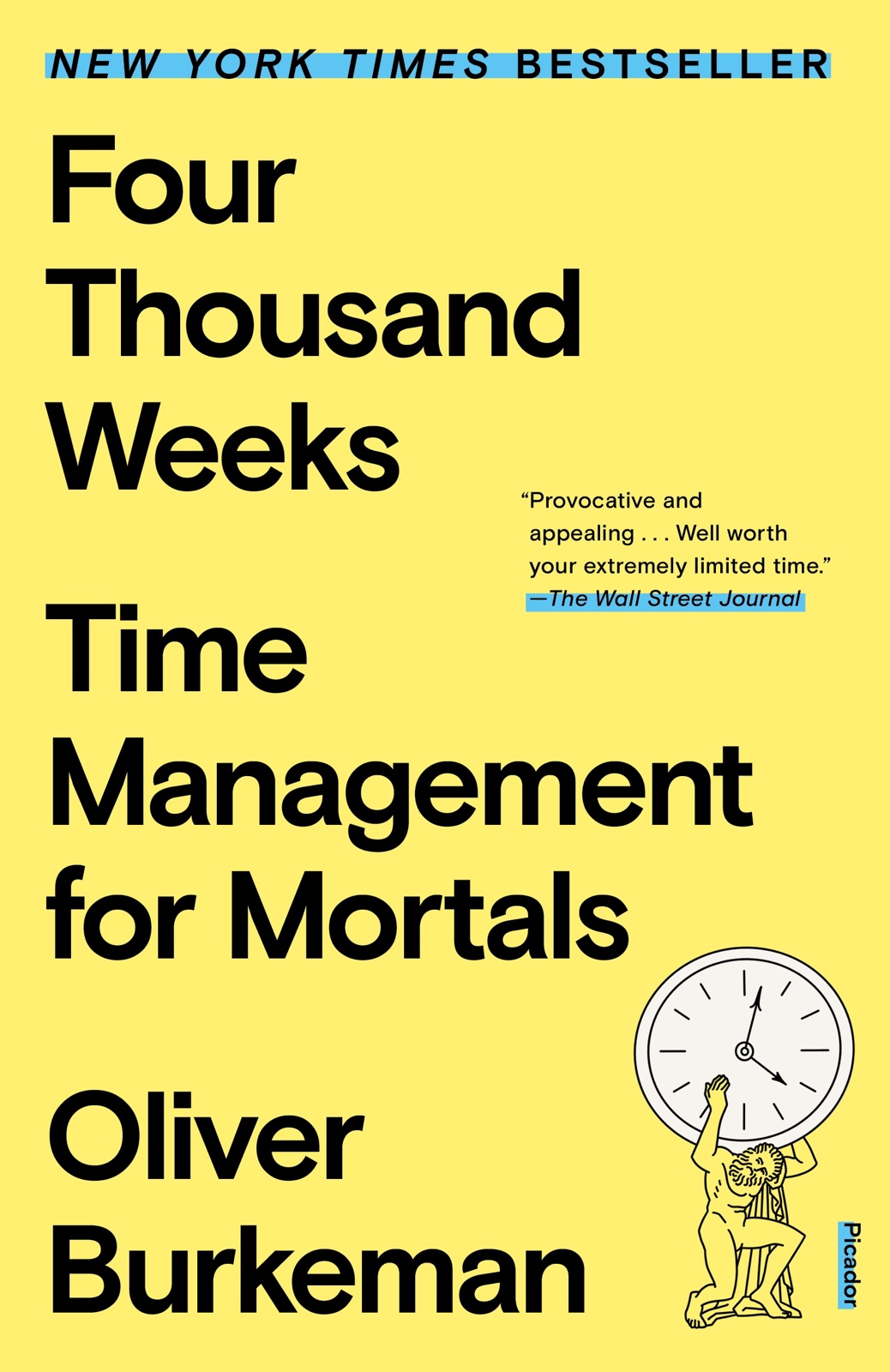
Four Thousand Weeks
Time Management for Mortals
An anti-productivity book that argues the goal isn't to get everything done, but to choose what matters.
Core ideas
You have roughly four thousand weeks alive. Efficiency will never let you do it all.
Productivity is a trap: clearing the decks only generates more demands.
Embrace finitude; meaning comes from accepting limits, not transcending them.
Choosing what to neglect is the real skill. Every yes is a thousand nos.
Lessons from the book
The efficiency trap
Clearing the decks just invites more ships.
Answer email faster and you receive more email. Become the person who gets things done and more things arrive to be done. Burkeman's point is structural: in a world of infinite inputs, efficiency does not create open space, it creates capacity that the world immediately fills. The finish line recedes as you run.
The trap is believing that one more system will finally get you on top of it all, after which real life can begin. There is no such moment. The liberating move is to stop treating busyness as a temporary emergency and admit the inbox will die unfinished along with the rest of the list. Everyone's does.
Choose what to neglect
Strategic underachievement: decide in advance what you will be bad at.
If you cannot do everything, the only real question is what you will fail at, and whether you choose it or let it be chosen for you. Burkeman recommends deciding on purpose: seasons where the garden goes wild, years where ambition at work idles while children are small. Failing deliberately at the right things is a skill.
He borrows a hard rule for the rest: pay yourself first with time, fixing the hours for what matters most before the demands arrive, and cap work in progress. Three projects, not thirty. The pain of the rule is the point. Saying no to genuinely good things is what a finite life costs.
Cosmic insignificance therapy
The universe does not need your to-do list finished, and that is a relief.
The pressure to use time perfectly rests on a grandiose assumption: that your life must add up to something remarkable to have been worth it. Burkeman prescribes a dose of scale. Against the age of the universe, nearly everything anyone has done is already forgotten, and yours will be too. He means this kindly.
Released from mattering cosmically, you get to matter locally: the meal cooked, the friend heard, the small work done with full attention. The four thousand weeks stop being a container to optimise and become the whole show, watchable only at the speed it plays.
Our take
Think of this as the antidote to every other productivity book on this shelf, including the ones we love. Burkeman's premise is that you will never get on top of everything, because the to-do list is infinite by design, and the sooner you accept how finite your time really is, the freer you become to choose what actually matters.
It's less a system than a shift in perspective, and it can feel bleak before it feels liberating. We found it genuinely consoling: once you stop trying to do it all, you can do the few things that count with your whole attention. Read it when you're burnt out on optimisation and not sure why none of it made you happier.
Is it for you?
Read it if
Anyone burnt out by optimisation culture who wants to make peace with limited time.
Skip it if
Readers looking for tactics, tools, or a system to do more in less time.