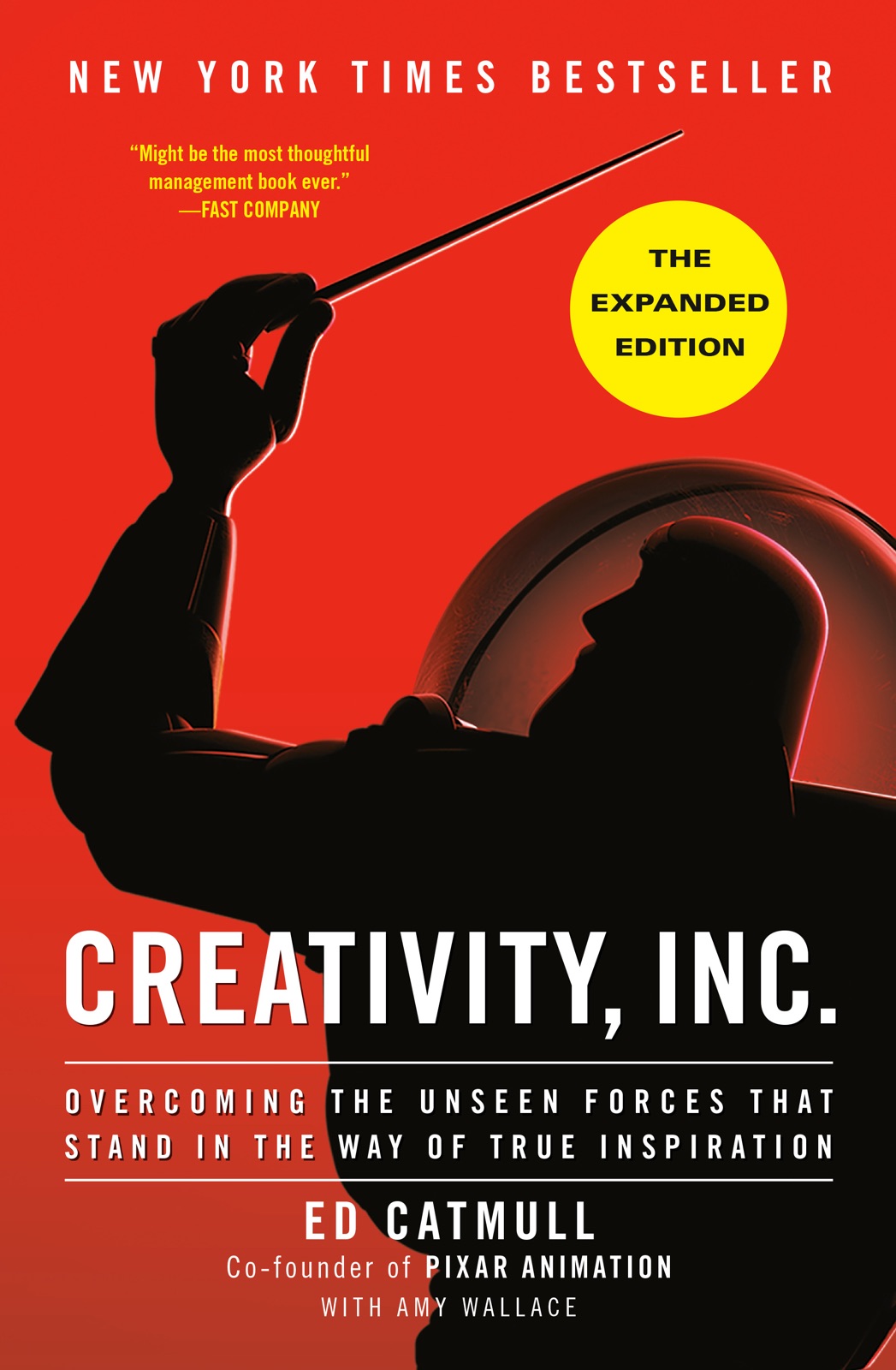
Creativity, Inc.
Overcoming the Unseen Forces That Stand in the Way of True Inspiration
The clearest field manual for running a team where people tell each other the truth.
Core ideas
The Braintrust gives candid feedback but holds no power to force changes on the director.
Every Pixar film starts bad; the work is turning a rough first version into a good one.
New ideas are fragile, so protect them from harsh judgement before they can stand up.
Fear and hierarchy quietly silence honesty, and leaders have to keep clearing them away.
Lessons from the book
The Braintrust runs on candour, not command
Strip the authority out of feedback and people finally tell the truth.
When a Pixar film is in trouble, the director sits with a group of experienced peers who watch an early cut and say plainly what is not working. This is the Braintrust. The one rule that makes it work is that the group has no power. They cannot mandate a single change. They give their honest read, and the director decides what to do with it.
This matters more than it looks. When feedback comes with authority attached, people brace for orders and stop listening. Remove the authority and the notes become a gift rather than a threat. The director stays the owner of the film, so defensiveness drops and real problems surface early. Catmull is clear that trust is what powers the room. People can be blunt because everyone knows the aim is a better film, not a scored point.
Every film starts bad on purpose
The first version is meant to be ugly; iteration is the actual plan.
Catmull says early versions of all their films are bad. Not a little rough, genuinely bad. This is not a failure to manage; it is the expected starting point. The work of the studio is the long grind of turning a weak first attempt into something good through many rounds of notes, rewrites and rebuilds. Nobody expects the first cut to be right.
Toy Story 2 is the sharp example. The film was heading out as a weaker straight-to-video sequel, and the team decided to rebuild it under punishing time pressure to meet the standard they wanted. It became one of their best-loved films. The lesson is that quality came from being willing to tear down and redo, not from getting it right first time. If you treat the rough draft as the enemy, you kill the process that makes good work possible.
Leaders make candour safe or watch it die
Fear and rank shut people up long before anyone says so out loud.
Catmull's central worry is the unseen forces that stop people speaking. Fear of looking foolish, fear of the boss, the quiet pull of hierarchy: these silence the very warnings a leader needs. Nobody announces that they are staying quiet. The honesty just never arrives, and problems grow in the dark until they are costly. A leader's job is to keep hunting for these forces and clearing them away.
The practical tools are ordinary and repeatable. Postmortems after each project force teams to name what went wrong while it is fresh, and doing them every time stops any single one feeling like blame. New ideas get protected too. Catmull calls a fragile new concept an ugly baby, something that looks weak early and would be crushed if judged too soon. Protecting it long enough to grow is a deliberate act, and it only works if people trust that speaking up is safe.
Our take
We keep coming back to this one because it is a management book with an actual heartbeat. Catmull is not selling a framework; he is describing what it felt like to keep a creative company honest for thirty years, and the honesty is the whole point. The Braintrust chapter alone is worth the price. It is a simple idea, a room of trusted peers who tell a director exactly what is not working, with the crucial rule that they cannot order any change. That single design choice, feedback without authority, is more useful than most leadership courses.
The honest caveat: this is Pixar's story told by Pixar's own president, so success bias is baked in. We hear how the good decisions paid off, and far less about the teams that ran the same playbook and still failed. Some of the advice also assumes a creative studio with patient owners and long timelines, which will not map cleanly onto a business that ships every fortnight. Take the principles, the candour and the iteration, and adapt the rituals to your own constraints rather than copying them wholesale.
Is it for you?
Read it if
Read it if you lead a team or run a project and want people to speak up before problems become expensive.
Skip it if
Skip it if you want a step-by-step system, as this is a story-led memoir that trusts you to draw the lessons.