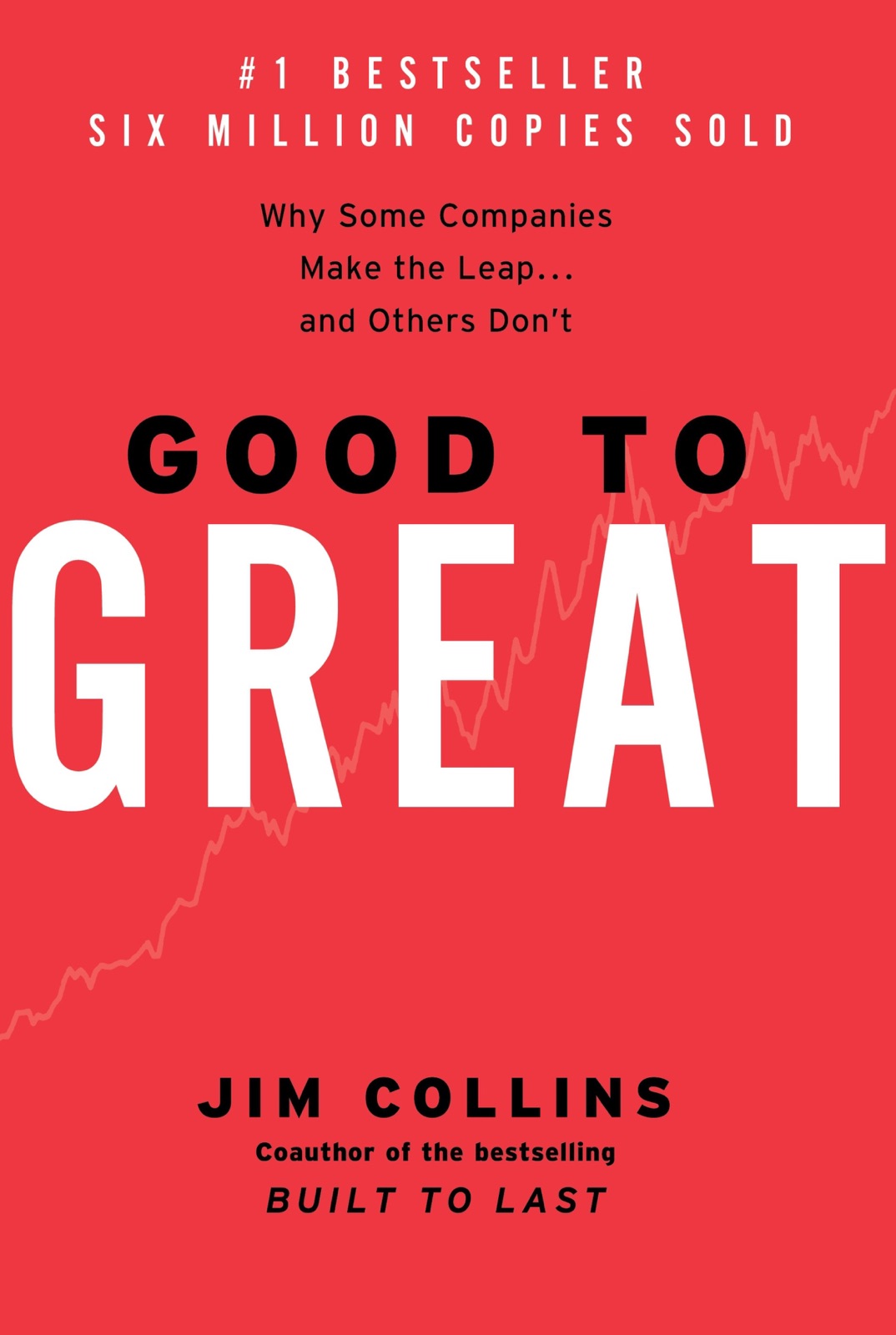
Good to Great
Why Some Companies Make the Leap and Others Don't
A data-driven study of what separates merely good companies from enduringly great ones.
Core ideas
Level 5 leaders blend deep personal humility with fierce professional will.
First who, then what: get the right people on the bus before deciding where to drive.
Confront the brutal facts while keeping faith you'll prevail (the Stockdale Paradox).
The Hedgehog Concept: do the one thing you can be best in the world at.
Lessons from the book
Level 5 leadership
The best-performing CEOs in the study were humble in person and ferocious about the mission.
Collins expected charismatic saviours at the top of his great companies and found the opposite: quiet, often awkward executives who deflected credit to their teams and took blame personally. What they shared was not modesty for its own sake but a fierce, almost impersonal will aimed at the company rather than their own image.
He calls the combination Level 5: personal humility plus professional will. The window-and-mirror habit captures it. When things go well, a Level 5 leader looks out the window to credit others and luck. When things go badly, they look in the mirror. Celebrity CEOs, his data suggested, tend to reverse the glass.
First who, then what
Strategy is easier to change than people. Choose the people first.
The great companies in the study did something backwards: they assembled the right team before settling strategy. Collins's bus metaphor stuck for a reason. Get the right people on the bus and the wrong people off, and the route can change as the world does; the bus still goes somewhere good.
The practical edge is in the hard half: acting on the wrong seats. Rigorous, he insists, is not ruthless, but letting a known mismatch linger is unfair to everyone, especially the mismatched person. His test: would you hire them again today, knowing what you know? If not, the kindest path is rarely waiting.
The hedgehog and the flywheel
Find the one intersection you can win, then push in the same direction for years.
The Hedgehog Concept is three questions held together: what can you be the best in the world at, what drives your economic engine, and what are you deeply passionate about? Not goals, but a filter. Great companies said no to everything outside the intersection, however profitable it looked.
The flywheel is how the filter pays off. No single push moves a massive wheel, but consistent pushes in one direction accumulate until momentum takes over and growth looks sudden from outside. The doom loop is the alternative: lurching between programs and saviours, restarting the wheel each time. Consistency, not drama, was the differentiator.
Our take
Collins set out to find what makes some companies leap from good to great, and the ideas that came out, Level 5 leadership, first who then what, the Hedgehog Concept, entered the business vocabulary for a reason. The writing is clear and the concepts are memorable enough to actually use.
The honest caveat is survivorship bias: studying winners after the fact can't fully prove what caused the winning, and a few of his star companies later stumbled badly. We still find the principles useful as questions to ask yourself, especially about having the right people on the bus, as long as you hold the grander conclusions a little loosely.
Is it for you?
Read it if
Managers and founders who want evidence-based principles over personality.
Skip it if
Readers wary of survivorship bias in business-success case studies.