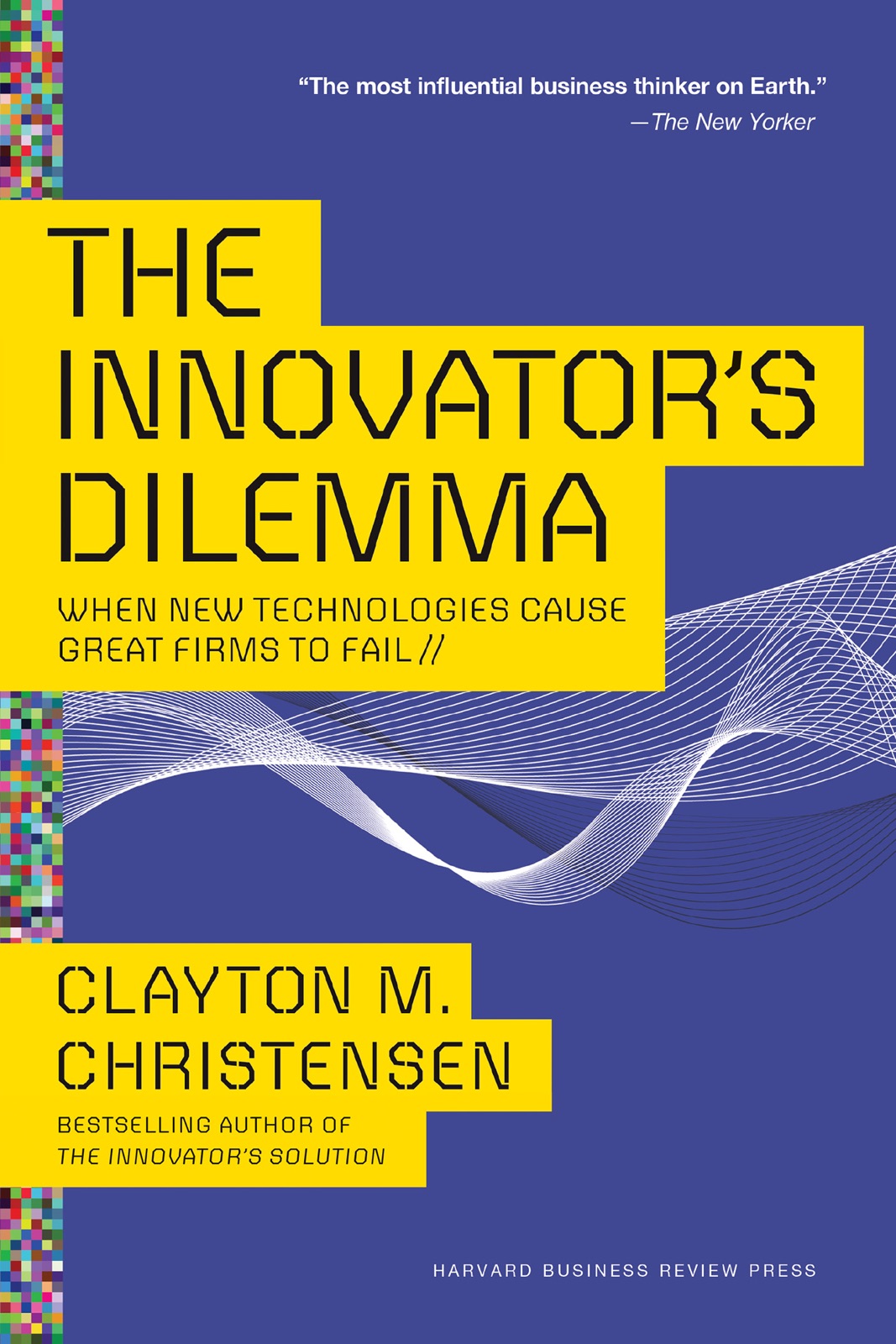
The Innovator's Dilemma
When New Technologies Cause Great Firms to Fail
Explains why great, well-run companies get destroyed by cheaper, worse-looking newcomers.
Core ideas
Doing everything right, listening to your best customers, can still doom a firm.
Disruptive tech starts worse and cheaper in a fringe market, then climbs.
Resource allocation always flows to the biggest customers and fattest margins.
The fix: a small, autonomous unit sized to the new, tiny market.
Lessons from the book
Good management is the trap
The decisions that make a firm successful are the same ones that leave it exposed.
Christensen's central puzzle is that the failed firms were not badly run. They were run brilliantly. They studied their customers, invested in better products, and moved money toward the highest returns. That is exactly what business schools teach, and it works, until a disruptive technology appears. The problem is that these habits are so deeply built into a healthy company that they cannot be switched off when they suddenly point in the wrong direction.
Think of the integrated steel mills. When cheap minimills like Nucor started making crude rebar, the big mills were happy to walk away. Rebar was their least profitable product. Retreating to fancier steel raised their margins every single time. Each step was rational, and each step handed more ground to the minimills, who kept climbing upmarket until almost nothing was left. Sound management did not save them. It marched them off the cliff one sensible decision at a time.
How disruption climbs from below
New technology does not start better, it starts cheaper and worse, then it improves.
A disruptive product almost always looks like a toy at first. It is cheaper, simpler, and performs worse than what the market wants, so incumbents dismiss it. Christensen tracked this in disk drives across generations: each smaller drive stored less and cost the leaders customers, so they ignored it. But performance improves faster than customer needs rise. The cheap, small drive eventually gets good enough for the mainstream, and by then the newcomer owns the market.
The excavator story is the clearest picture of this. Cable-operated shovels dug huge volumes and ruled the big construction sites. The new hydraulic diggers were tiny and could only handle small jobs, so the cable makers saw no threat and no customers asking for them. Hydraulics found a home in residential trenching, improved year after year, and then rose to swallow the main market. The incumbents did not lose because they missed the technology. They lost because their customers did not want it yet.
Build a separate boat
You cannot fight a small-market threat from inside a big-market company.
If the pull of your best customers and biggest margins is what kills you, then the fix is not more discipline. It is separation. Christensen's practical advice is to spin the disruptive project out into its own small, independent unit. Give it a tiny market it can actually be excited about, its own cost structure, and freedom from the parent company's revenue targets. A ten million dollar win means nothing to a giant, but it can be a triumph for a small team that is allowed to chase it.
The reasoning is about size and motivation. A large organisation needs large opportunities to move the needle, so a new market that starts small will always lose the internal fight for money and talent. A separate unit is judged on different terms and can treat the fringe market as its whole world. It can also fail cheaply and learn fast, which matters because nobody can predict where a disruptive market will actually go. The parent keeps running its profitable business while a smaller boat sails toward the storm.
Our take
This is the book that gave the word disruption its real meaning, and the core idea has held up better than almost any business theory from the 1990s. Christensen's argument is genuinely surprising: the incumbents do not fail because they are lazy or stupid. They fail because they are well managed. They listen to their best customers, chase their most profitable products, and back the projects with the clearest returns. Every one of those choices is correct in isolation, and together they blind a firm to the small, ugly technology growing up beneath it.
One honest caveat: the disk-drive chapters are dry, and Christensen leans hard on that one industry to build his case, so the middle stretches read more like an academic paper than a trade book. It is also worth knowing that disruption has since been watered down into a buzzword for anything new, and some sceptical scholars have questioned how well the theory actually predicts which firms will fall. We think the value is in the central mechanism rather than every case study, and that mechanism still explains a lot about why big companies stumble.
Is it for you?
Read it if
Read it if you run, invest in, or work inside an established business and want to see the threat coming before it arrives.
Skip it if
Skip it if you want quick startup tactics, as this is a careful, evidence-heavy study, not a playbook of hacks.