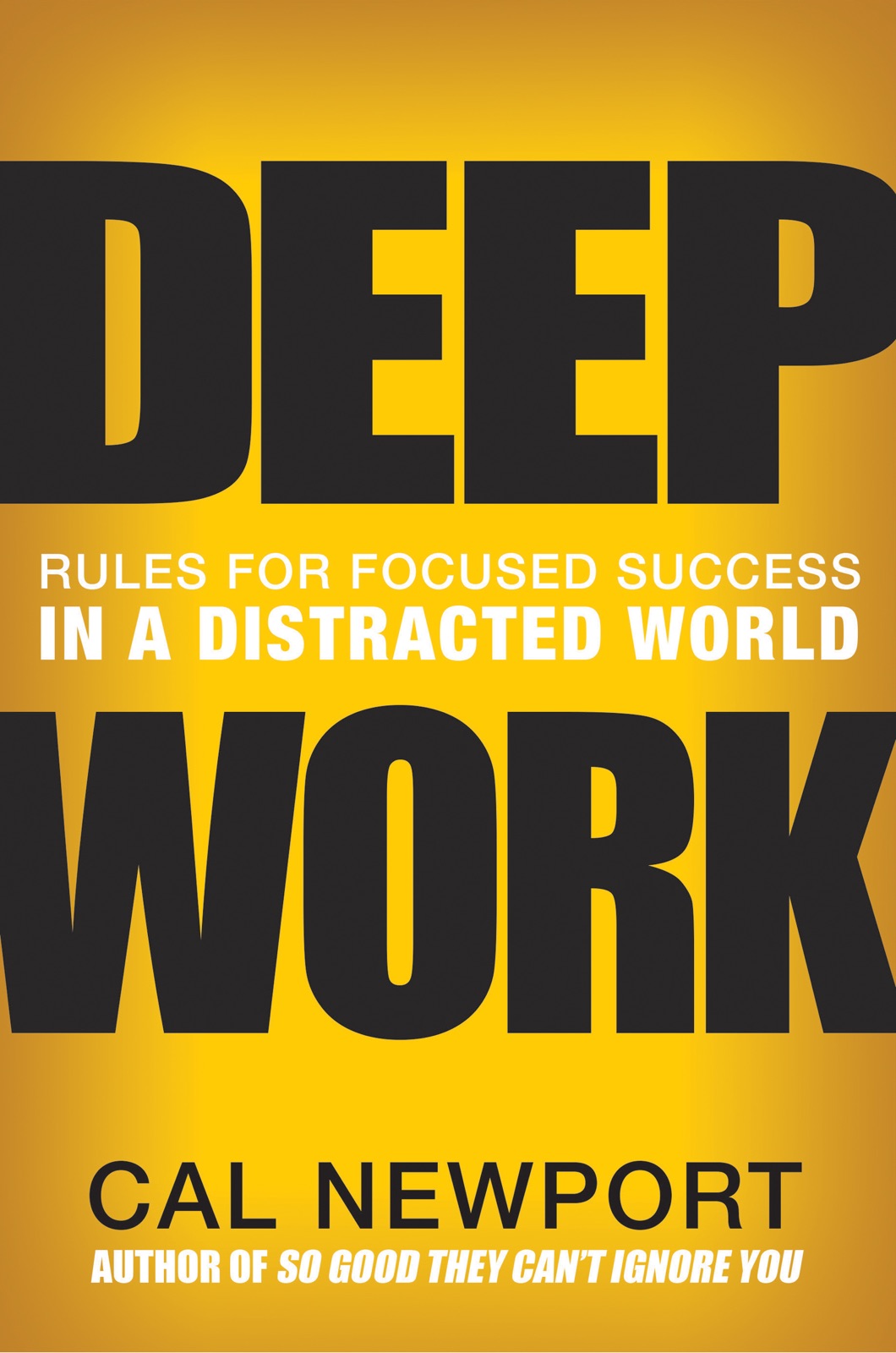
Deep Work
Rules for Focused Success in a Distracted World
The ability to focus without distraction is becoming rare exactly as it becomes more valuable.
Core ideas
Deep work, cognitively demanding focus, produces rare, high-value output; shallow work doesn't.
Concentration is a trainable skill that atrophies with constant context-switching.
Schedule deep work like an appointment; willpower is finite, so design beats discipline.
Embrace boredom and quit shallow distractions to keep your attention strong.
Lessons from the book
The deep work hypothesis
Focus is becoming rarer and more valuable at the same time. That gap is your opening.
Newport's economic argument comes first. As machines and markets absorb routine work, the valuable human skills become learning hard things quickly and producing at an elite level, and both depend on long, undistracted concentration. Meanwhile open offices, chat, and phones are training the exact opposite capacity into knowledge workers.
When something grows scarcer and more valuable simultaneously, whoever still has it wins outsized returns. That is the deep work hypothesis in one line. The book's promise is not calm or balance, though those arrive too. It is that focus is now a career-defining economic asset, available to anyone willing to train it.
Rituals beat willpower
Schedule depth like a meeting, because your attention will not defend itself.
Newport's practitioners share one habit: they decide in advance when and where depth happens. A morning block behind a closed door, a weekly day in the library, even a full monastic retreat. The form matters less than the contract. When depth is an appointment, it survives days when motivation does not.
He is equally practical about the edges: a shutdown ritual that closes the workday so the mind stops rehearsing, quotas for shallow work, and a visible scoreboard of deep hours. Willpower is a battery, not a character trait. Rituals are how you spend it once instead of draining it hourly on the decision to focus.
Embrace boredom
A mind that reaches for the phone at every red light cannot go deep on command.
The counterintuitive chapter is not about work at all. Newport argues that attention is trained around the clock, and every idle moment filled with a glance at a screen teaches your brain that boredom is intolerable. A mind conditioned that way will not hold a hard problem for ninety minutes, whatever the calendar says.
The prescription flips the usual framing: do not take breaks from distraction, take breaks from focus. Let queues and commutes stay boring. Give your mind one demanding thing and let it sit with the discomfort. Tolerance for boredom, unglamorous as it sounds, is the substrate every other technique in the book stands on.
Our take
If you think for a living and can't remember the last time you concentrated for two unbroken hours, this book will land hard. Newport's argument is simple and a little alarming: the ability to focus deeply is becoming both rarer and more valuable at the same time, and most of us are quietly trading it away for notifications.
What we appreciate is that he doesn't just diagnose the problem. He gives you ways to rebuild the muscle, from scheduling focus like a meeting to getting comfortable with boredom. It can read a touch absolutist (not everyone can wall themselves off for hours), but adopting even a fraction of it noticeably lifts the quality of what you make.
Is it for you?
Read it if
Knowledge workers, students, and creatives whose best work needs uninterrupted concentration.
Skip it if
Those in roles defined by rapid response and constant availability who can't restructure their day.