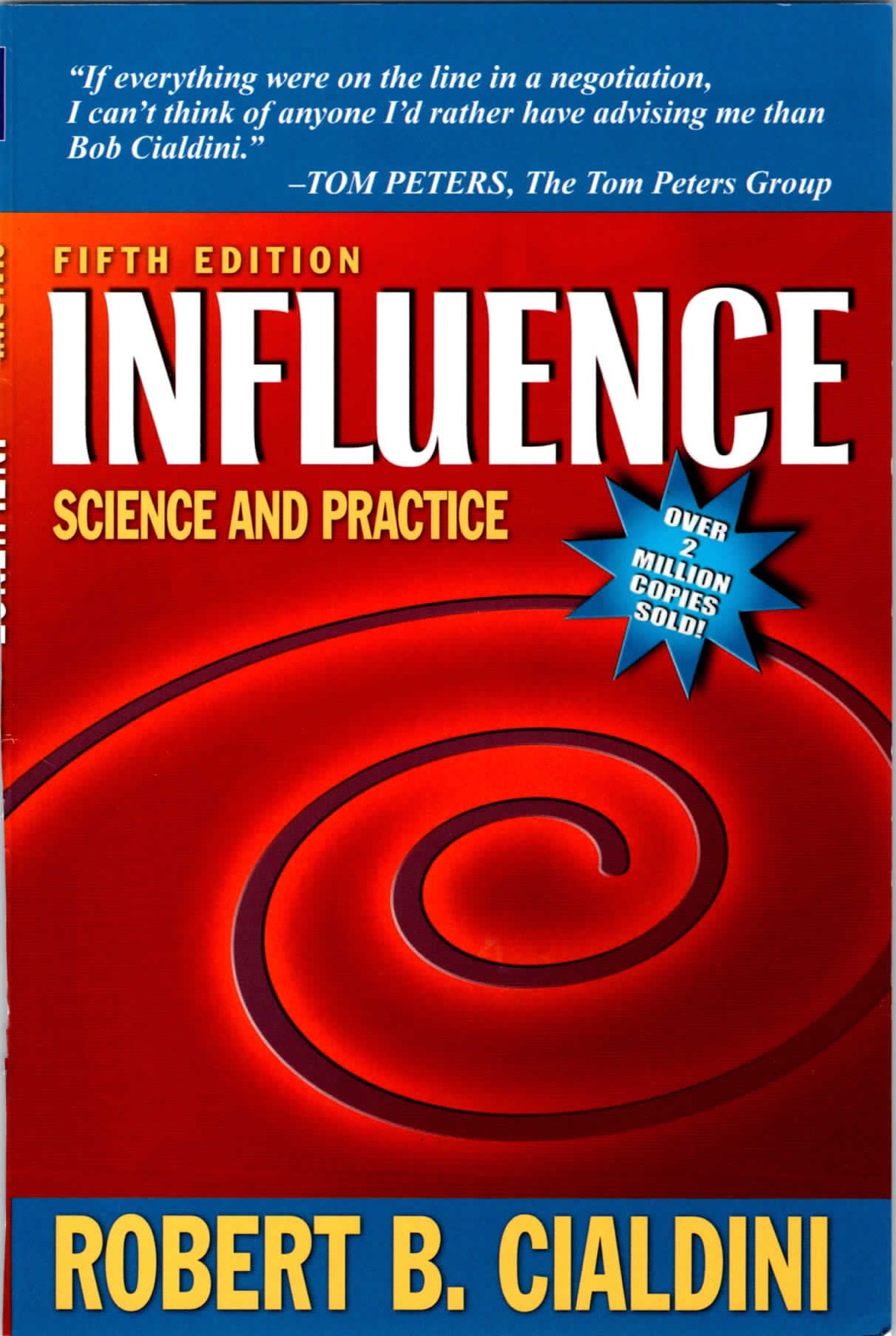
Influence
The Psychology of Persuasion
The definitive study of why people say yes, and how to defend yourself from manipulation.
Core ideas
Six levers drive compliance: reciprocity, commitment, social proof, authority, liking, and scarcity.
Reciprocity is powerful enough that an unsolicited gift creates a sense of obligation.
We follow the crowd most when we're uncertain and the crowd is like us.
Recognising these triggers is the only real protection against them.
Lessons from the book
The six levers of yes
Reciprocity, commitment, social proof, authority, liking, scarcity. Compliance runs on shortcuts.
Cialdini spent years inside sales trainings and fundraising operations, and found the same six principles doing the work everywhere. Each one is a mental shortcut that usually serves us well: repay favours, act consistently with commitments, follow the crowd, defer to experts, agree with people we like, and value what is scarce.
The shortcuts exist because they are usually right, and that is what makes them exploitable. A compliance professional does not argue you into yes; they arrange the situation so a shortcut fires. The book teaches you to recognise the arrangement, which is a different and more useful skill than resisting arguments.
Reciprocity's quiet debt
An unsolicited gift creates an obligation you did not agree to carry.
Of the six, reciprocity is the heavyweight. The free sample, the address labels in the charity mailer, the concession in a negotiation: each plants a small debt, and humans across every culture feel discomfort until debts are repaid. Crucially, the rule fires even when the gift was unwanted.
Cialdini's most useful observation is the rejection-then-retreat move: an inflated request, refused, followed by the real one, which now reads as a concession you should match. The defence is to redefine the situation. A gift given to trigger repayment is not a gift; it is a sales device, and devices cancel the debt.
Defence against the dark arts
You cannot switch the triggers off. You can learn to notice the click.
The principles are wired in, so the goal is not immunity but detection. Cialdini's own habit is to watch for the feeling of automatic momentum, the click-and-run of a shortcut firing, especially when urgency, flattery, or manufactured scarcity is present. The alarm is that hurried, slightly pressured feeling itself.
His test question is clean: would I still want this if the trigger vanished? Would I buy without the countdown timer, agree without the free lunch, comply without the title on the badge? If the answer changes, the trigger was doing the deciding. Pause, and the automatic yes usually dissolves.
Our take
Once you read this, you start seeing its six principles everywhere: in ads, in store layouts, in the way a good salesperson works you. That's exactly the point. Cialdini wrote it as much to help you defend yourself as to persuade anyone else, and the awareness alone is worth the cover price.
It's grounded in real research but reads like a collection of great stories, which is why it sticks. We'd call it close to required reading for anyone in marketing or sales, but honestly it's just useful for becoming a harder target. The newer expanded edition adds a seventh principle, though the original is plenty to start with.
Is it for you?
Read it if
Marketers, negotiators, and anyone who wants to understand persuasion from both sides.
Skip it if
Readers hoping for manipulative scripts rather than principles and ethics.