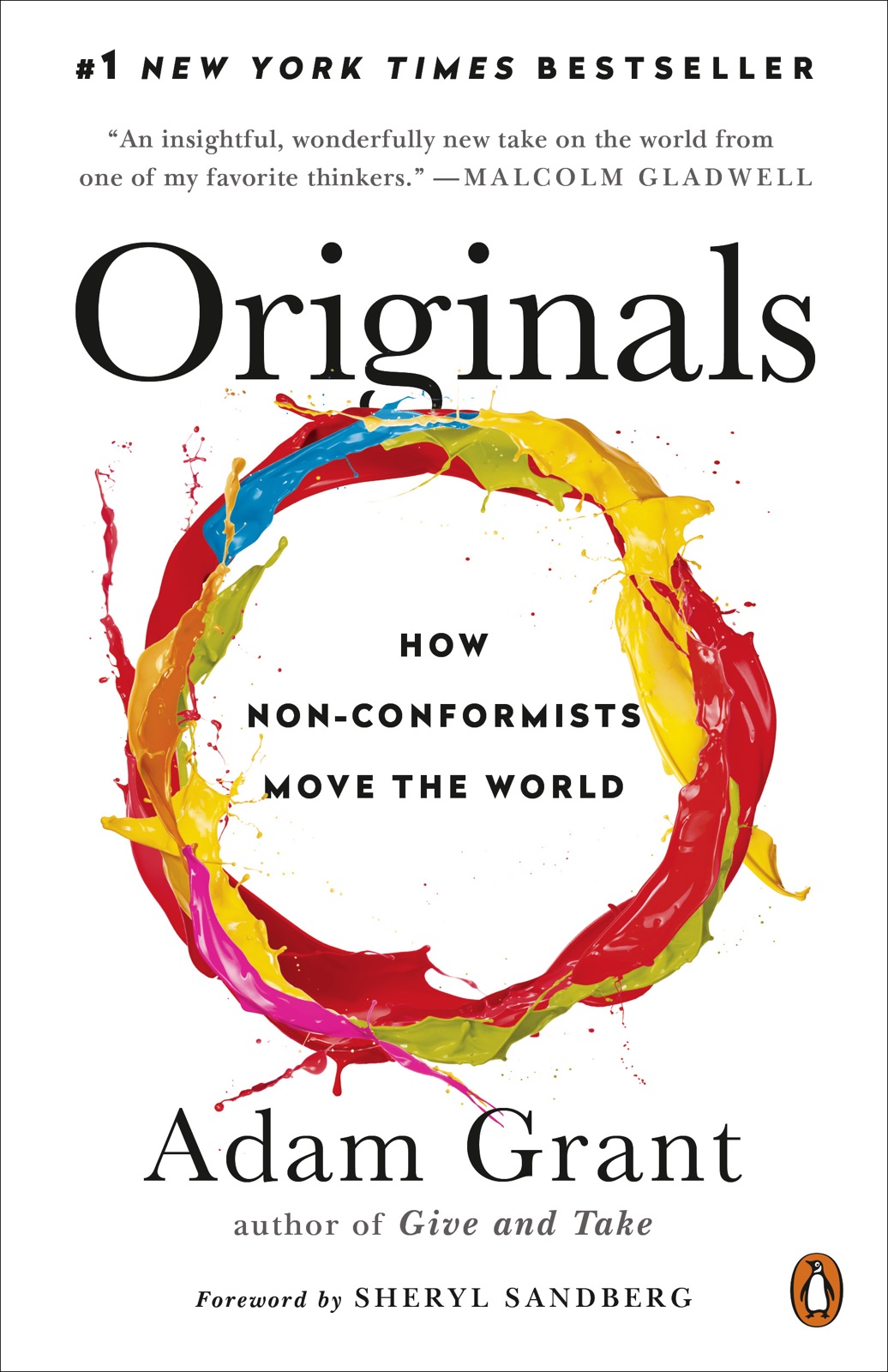
Originals
How Non-Conformists Move the World
The research-backed case that original thinkers are more cautious and less certain than the myth suggests.
Core ideas
Original people hedge their bets: many keep the day job while building the risky thing.
Quality comes from volume, so generate far more ideas than you think you need.
Question defaults instead of accepting that things must be the way they are.
To be heard, lead with your idea's weaknesses and repeat it until it feels familiar.
Lessons from the book
Keep the day job
The bold founder who bets everything is mostly a myth.
We picture the original as someone who quits, burns the boats, and goes all in. Grant shows the pattern is usually calmer than that. The founders of Warby Parker, the eyewear company, kept their studies and jobs while they built the business on the side. That looked like weak commitment to some investors. It was actually sensible. A safety net in one part of your life frees you to take real risks in another.
The lesson is not to be reckless in order to prove you are serious. Hedging your bets buys you time and calm to make the risky idea work. You can be deeply committed to a new venture and still refuse to gamble the rent on it. If you have held back from a project because you are not willing to quit everything for it, this reframes that caution as a feature, not a failure of nerve.
Volume beats genius
The way to have good ideas is to have a lot of ideas.
We tend to imagine great creators as people who produce a few perfect works. Grant argues that the most original people are simply the most productive. They generate far more than the rest of us, and a larger pile means more chances at something great. The output is not all brilliant. Edison held huge numbers of patents, and most are forgotten. Bach wrote a vast amount of music, and only some of it is played today.
The practical point is to stop waiting for the one flawless idea. Push out quantity, then judge hard afterwards. Your own sense of which idea is best is often wrong, so you need volume to give yourself real options to choose from. This also takes pressure off any single attempt. If you expect most of what you make to be ordinary, a weak draft stops feeling like proof that you have run out of good ideas.
Question the default
Ask why things are the way they are before you accept them.
Most of us treat the way things are set up as simply given, like the layout of a keyboard or the rules of an office. Grant calls the opposite habit vuja de: looking at something familiar with fresh eyes, as if seeing it for the first time, and asking why it works this way at all. Originals do this by default. They notice that a rule is a choice someone once made, not a law of nature, and choices can be remade.
You can practise this without a grand mission. Pick one process you follow at work that everyone treats as fixed and ask who decided it and why. Often the honest answer is that no one remembers, which is your opening. Questioning defaults is not the same as complaining. It is the first, quiet step that lets a better version of a thing become thinkable in the first place.
Our take
We like this book because it argues against a comforting lie. The story we tell about creative people is that they are fearless risk-takers who bet everything on a hunch. Grant says the opposite is closer to the truth. The people who change things often doubt themselves, delay, and keep a safety net. That framing is genuinely useful if you have ever felt too cautious to count as original. The message is that caution and originality can live in the same person.
Our caveat is the shape. This is pop-psychology, so it runs on memorable stories and studies, and the stories were often picked after the fact to fit the point. Some of the research it leans on dates from years when psychology was still sorting out which findings held up under repetition, so treat the numbers as suggestive rather than settled. Read it for the mindset and the good questions, not as a proven formula you can follow to a result.
Is it for you?
Read it if
Read it if you want to back a new idea at work or in your own venture and worry you are not the bold, all-in type.
Skip it if
Skip it if you want a step-by-step system rather than a tour of studies and stories about why originals behave as they do.