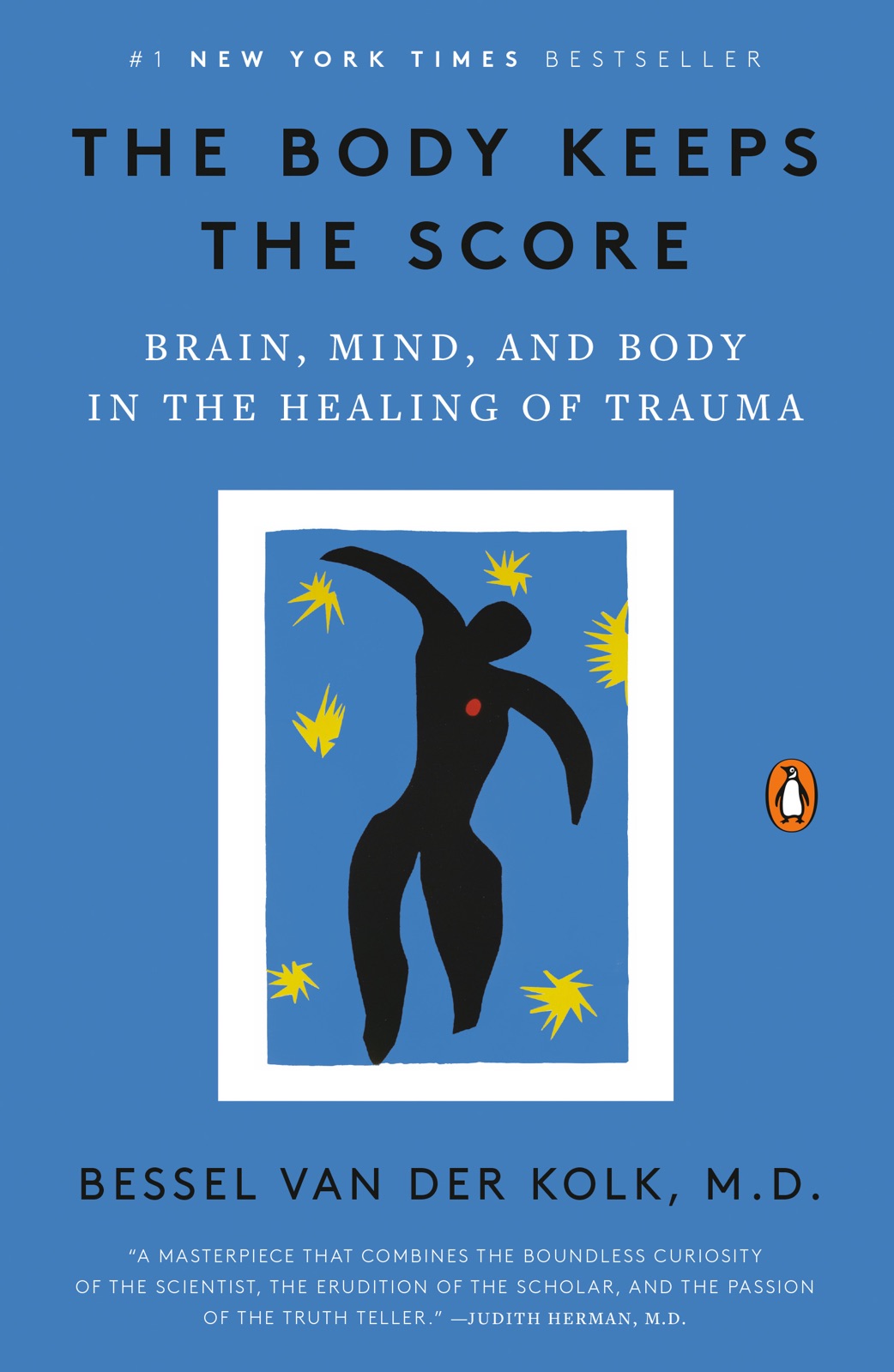
The Body Keeps the Score
Brain, Mind, and Body in the Healing of Trauma
Trauma lives in the body and nervous system, not just in memory, and healing has to include both.
Core ideas
Trauma is not the event itself but the imprint it leaves on body, brain, and nervous system.
Under flashback, the brain's alarm centres fire while the reasoning and speech centres go quiet.
Talk therapy alone is often not enough, because trauma is stored below the level of language.
Recovery runs through safety and the body: rhythm, movement, yoga, EMDR, and safe relationships.
Lessons from the book
Trauma is an imprint, not a memory
The event ends. The body's alarm keeps ringing.
Van der Kolk's central finding is that trauma is not stored like a normal memory with a beginning and an end. It persists as fragments: sensations, images, and a nervous system stuck on high alert. Survivors are not so much remembering the event as reliving pieces of it, triggered by cues they often cannot name.
Brain imaging makes this concrete. During flashbacks, the alarm centres light up while the speech centre goes quiet, which is why the experience can be literally hard to put into words. Understanding this replaces shame with physiology, and that shift is itself a step toward healing.
The smoke detector stuck on high
After trauma, the brain misreads ordinary life as danger.
He describes the amygdala as a smoke detector. After overwhelming experience it recalibrates, treating neutral signals as smoke: a tone of voice, a smell, a crowded room. The rational brain knows better, but it is slower and quieter than the alarm, and it loses that race every time.
The consequences look like personality but are physiology: hypervigilance, numbness, rage that arrives before thought. His point for families and colleagues is that these are protective systems doing their job too well. The question that helps is not what is wrong with you, but what happened to you.
Healing goes through the body
Safety, rhythm, and movement reach places argument cannot.
The second half of the book surveys what actually helps: EMDR, trauma-informed yoga, neurofeedback, theatre, and above all relationships in which the survivor feels physically safe. What unites them is that they work from the body upward, restoring a sense of being at home in oneself before asking for a tidy narrative.
Van der Kolk is candid that no single method fits everyone and recovery is rarely linear. The encouraging part is that the same plasticity that let trauma rewire the brain allows repair. Treat the book as a map for choosing help alongside a trauma-informed professional, not as a self-treatment manual.
Our take
This is a serious clinical book that became a bestseller because it explains something millions of people recognise in themselves: why the past keeps intruding on the present through the body. Van der Kolk spent forty years treating trauma, and the through-line of his account is that the body and nervous system carry what the mind cannot yet process.
We include it with care. The case histories involve abuse and war, and it can be a hard read for survivors, so go slowly and set it down when needed. Some treatments he champions have stronger evidence than others, and parts are debated among clinicians. But as a map of what trauma is and why willpower alone does not undo it, nothing else we list comes close.
Is it for you?
Read it if
Survivors, their families, and anyone in a caring profession who wants to understand trauma seriously.
Skip it if
Readers looking for a light self-help read. It is clinical, heavy, and describes abuse in detail.