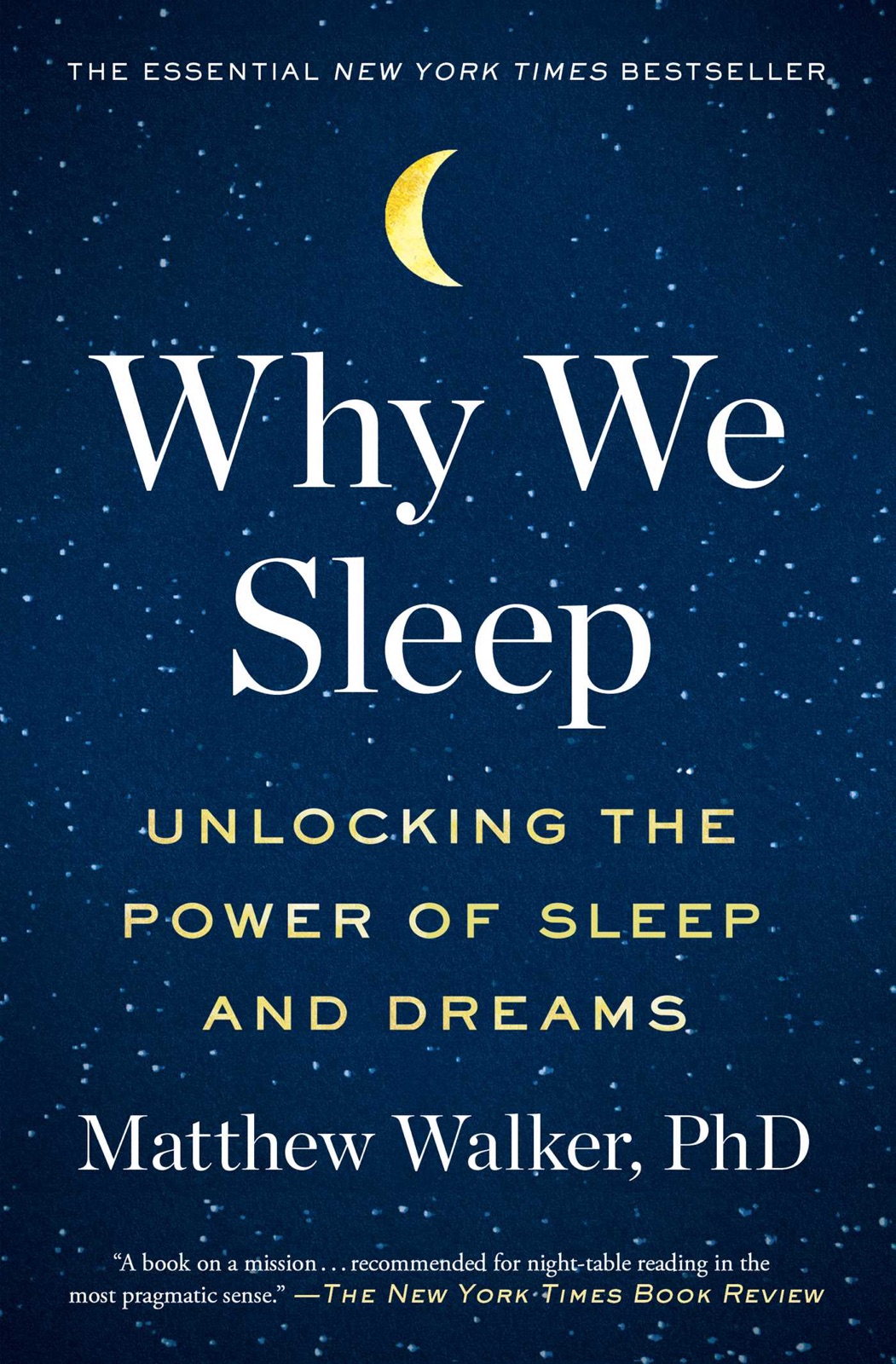
Why We Sleep
Unlocking the Power of Sleep and Dreams
A sleep scientist's case that sleep is the single most effective thing you can do for your health.
Core ideas
Sleep isn't downtime: it consolidates memory, regulates emotion, and clears the brain.
Routinely sleeping under seven hours is linked to serious long-term health damage.
Caffeine and alcohol quietly wreck sleep quality even when you fall asleep fine.
Consistency, meaning the same sleep and wake times, matters more than most people realise.
Lessons from the book
The night shift is a job
While you sleep, the brain files memories, processes emotion, and takes out the trash.
Walker's core correction is that sleep is not the absence of activity. Deep sleep transfers the day's learning from fragile short-term storage into long-term memory. REM sleep runs a kind of overnight therapy, replaying emotional experiences with the chemical sting turned down. A rinse cycle clears metabolic waste from brain tissue.
Cut the night short and you skip specific shifts of this work. Six hours instead of eight does not cost you a quarter of the benefit; because deep and REM sleep concentrate at different ends of the night, it can gut one process almost entirely. The tiredness you feel is the least of what went missing.
Caffeine and alcohol, the two saboteurs
One blocks sleep pressure, the other fragments the night. Both lie to you.
Caffeine works by blocking adenosine, the chemical that builds sleep pressure through the day, and its quarter-life means a late-afternoon coffee still occupies receptors at midnight. You may fall asleep anyway, but shallower, and the crash when the block wears off demands more caffeine tomorrow. A quiet dependency loop.
Alcohol is worse because it impersonates help. It is sedation, not sleep: it fragments the night with micro-awakenings you do not remember and suppresses REM specifically. The nightcap that knocks you out is also confiscating the emotional and memory work your brain planned to do. Walker's rule of thumb: earlier for both, less of both.
Regularity is the master habit
Same bedtime, same waking time, weekends included. Everything else is refinement.
Asked for one intervention, Walker gives the least glamorous: go to bed and wake up at the same time every day, weekends included. The body's clock thrives on regularity, and the Monday jetlag of a weekend lie-in is real, self-inflicted, and repeated fifty-two times a year.
The supporting cast follows the biology: cool, dark rooms, dimming light an hour before bed, no screens at full blast, and getting out of bed if sleep will not come so the bed stays associated with sleeping. But regularity carries the most weight. It is free, boring, and more effective than any supplement.
Our take
This book scared us, in a useful way. Walker makes the case that chronically short sleep isn't a badge of toughness but a slow-acting health risk, and he piles up enough evidence that you'll struggle to look at your five-hour nights the same way again. Plenty of readers credit it with finally fixing their relationship with sleep.
One honest caveat: some of his strongest statistical claims have been challenged by other scientists since it came out, so don't treat every number as gospel. The big picture, though, isn't seriously in doubt: consistent, sufficient sleep is one of the highest-leverage things you can do for your body and mind. Read it, then just go to bed earlier.
Is it for you?
Read it if
Anyone who treats sleep as negotiable and wants the evidence to stop.
Skip it if
Readers who want a hyper-cautious literature review; some claims have been debated since.