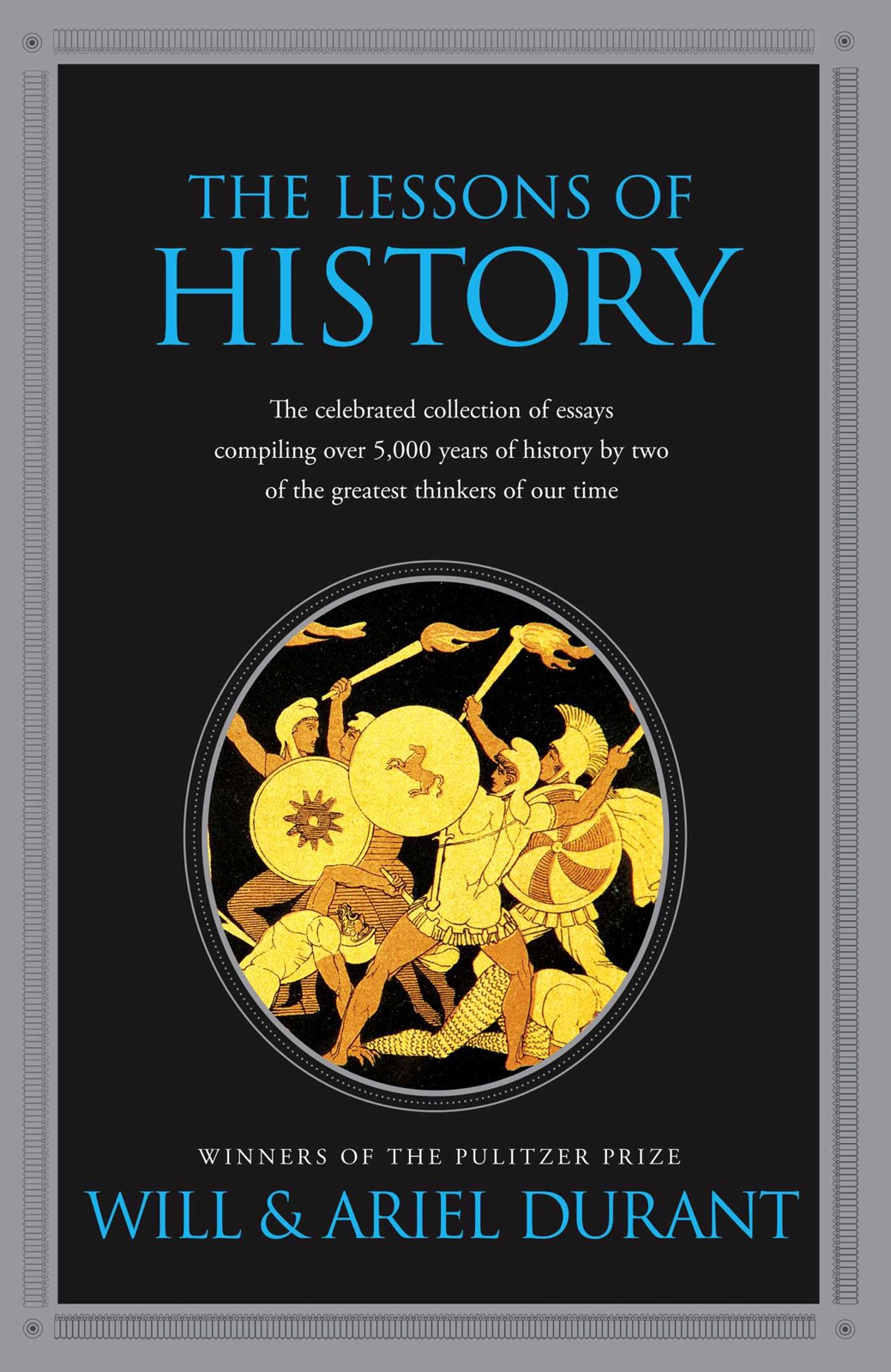
The Lessons of History
Fifty years of writing history, compressed into a hundred pages of what actually repeats.
Core ideas
History is biology first: life is competition and selection, and civilisation does not change human nature.
Freedom and equality pull against each other. Maximise one and the other contracts.
Wealth concentrates in every society until it is redistributed, peacefully or otherwise.
Morals shift with economic conditions, but the underlying human drives stay remarkably fixed.
Lessons from the book
History's first teacher is biology
Civilisation is a thin, recent layer over very old drives.
The Durants begin with a blunt premise: history is a fragment of biology, and the laws of life, competition, selection, and reproduction, keep operating underneath every civilisation. Cooperation is real, but it is usually competition organised at a larger scale: the team, the city, the nation competing as a unit.
This lens is not cynical so much as clarifying. Institutions, they argue, should be judged by how well they channel permanent human drives toward useful ends, not by whether they can abolish them. Five thousand years of recorded history show no evidence that human nature itself has changed. The stage changes; the play repeats.
The freedom and equality trade-off
The two things every society wants most work against each other.
The Durants observed that freedom and equality sit in permanent tension. Leave people fully free and their natural differences in talent, luck, and appetite produce inequality within a generation. Enforce strict equality and you must restrict freedom to do it. Every political system is a different settlement of this one trade.
They do not tell you where to set the dial. Their point is that anyone promising both maximised at once is selling something history has never delivered. Understanding the trade-off makes political argument less bewildering: most of it is the two goods being weighed differently by people who each see only one.
The concentration and release of wealth
Inequality grows until it is resolved, by reform or by revolution.
Across Athens, Rome, and every commercial society since, the Durants trace the same rhythm. Wealth concentrates, because ability is unevenly distributed and compounds. Concentration breeds instability. Eventually the gap is closed, either by legislation that redistributes some of it, or by upheaval that redistributes most of it violently.
Their reading of Athens under Solon is the hopeful version: the elite accepted painful reforms and pre-empted a revolution. Rome's republic is the other version. The lesson for the present is not a prediction but a maintenance schedule. Societies that release the pressure deliberately keep what societies that deny it lose.
Our take
The Durants spent four decades writing an eleven-volume history of civilisation, then distilled what they thought it all taught into this one-sitting book. The result reads like aphorisms backed by five thousand years of examples: on inequality's cycle, on freedom versus equality, on why war keeps returning. Some pages feel like they were written this morning.
It shows its age, and a few judgments from 1968 need reading with today's eyes. But as a companion to Sapiens it is remarkable. Harari asks how humans got here; the Durants ask what keeps happening once we arrive. For a book you can finish in two hours, it leaves an unusual amount of furniture in your head.
Is it for you?
Read it if
Anyone who wants the widest possible view of human patterns in a single sitting.
Skip it if
Readers who need footnotes, hedges, and current scholarship. It is confident, dated, and aphoristic.