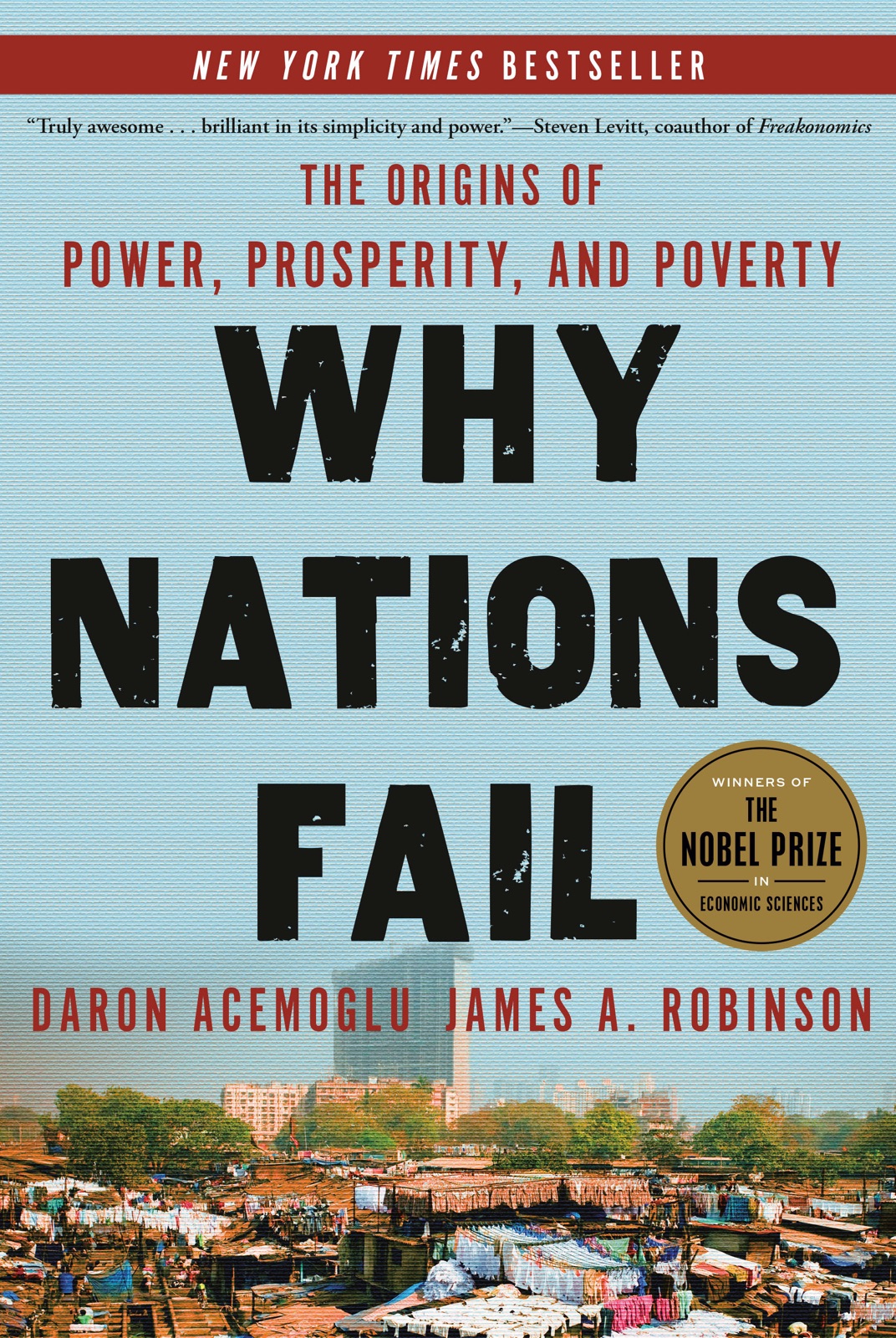
Why Nations Fail
The Origins of Power, Prosperity, and Poverty
Nations are rich or poor mostly because of their institutions, not their geography, culture, or climate.
Core ideas
Inclusive institutions spread power and reward effort. Extractive ones concentrate both, and poverty follows.
Nogales, Arizona and Nogales, Sonora share geography and culture. One fence, two destinies.
Extractive elites resist new technology because creative destruction threatens their position.
Critical junctures, plagues, revolutions, and crises, are the moments when institutions fork and history commits.
Lessons from the book
The tale of two Nogales
Same desert, same culture, same ancestors. The difference is the rules.
Nogales is one city with a fence through it. North of the fence: higher incomes, functioning courts, safe streets, teenagers in school. South: a fraction of the income and far less security. Geography cannot explain the gap, and neither can culture, since the families are often related. What changes at the fence is institutions.
Inclusive institutions protect property, enforce contracts evenly, and let anyone with a better idea enter the market. Extractive institutions funnel wealth toward whoever holds power. The authors spend five hundred pages testing this distinction against history, from colonial plantations to the Soviet Union, and the pattern holds with uncomfortable consistency.
Why elites strangle progress
New technology creates new winners, and the old winners usually get a veto.
Prosperity requires creative destruction: new tools and firms replacing old ones. But every wave of it threatens whoever profits from the current arrangement. Tsarist Russia and the Habsburgs resisted railways precisely because they feared what movement and industry would do to the social order. The Ottoman empire restricted printing for centuries.
This is the book's engine of poverty: elites who block change to protect extraction, and institutions that let them. It also explains why growth under extraction, like the Soviet spurt, eventually stalls. You can command resources into factories, but you cannot command the disruptive innovation that sustained prosperity needs.
Critical junctures and small differences
At history's forks, minor differences in institutions compound into destinies.
The Black Death killed half of Europe and cracked feudalism everywhere. In the west, where peasants already had slightly more bargaining power, labour scarcity became freedom and wages. In the east, lords doubled down and serfdom hardened. One shock, two paths, and the divergence echoed for five hundred years.
That is the authors' model of change: crises open the door, and the small institutional differences already in place decide who walks through it and where. It is a hopeful model in one sense, because nothing is destined. It is sobering in another, because the institutions you build in calm times decide what the next crisis does to you.
Our take
The book opens with one city split by a fence: Nogales, half in Arizona and half in Sonora. Same desert, same ancestry, wildly different lives. That natural experiment is the whole thesis in miniature. What differs is institutions: whether power and opportunity are broadly shared, or captured by an elite that extracts from everyone else.
Acemoglu and Robinson won the 2024 Nobel in economics largely for the research behind this book, which tells you how seriously the argument is taken. Critics fairly say it explains too much with one lever. Read it against Guns, Germs, and Steel: geography versus institutions is one of the great arguments in social science, and holding both makes you sharper than either alone.
Is it for you?
Read it if
Readers who want one big, argued answer to why some countries prosper, with history as the evidence.
Skip it if
Those who want balance across competing theories. It is a five-hundred-page argument for one thesis.