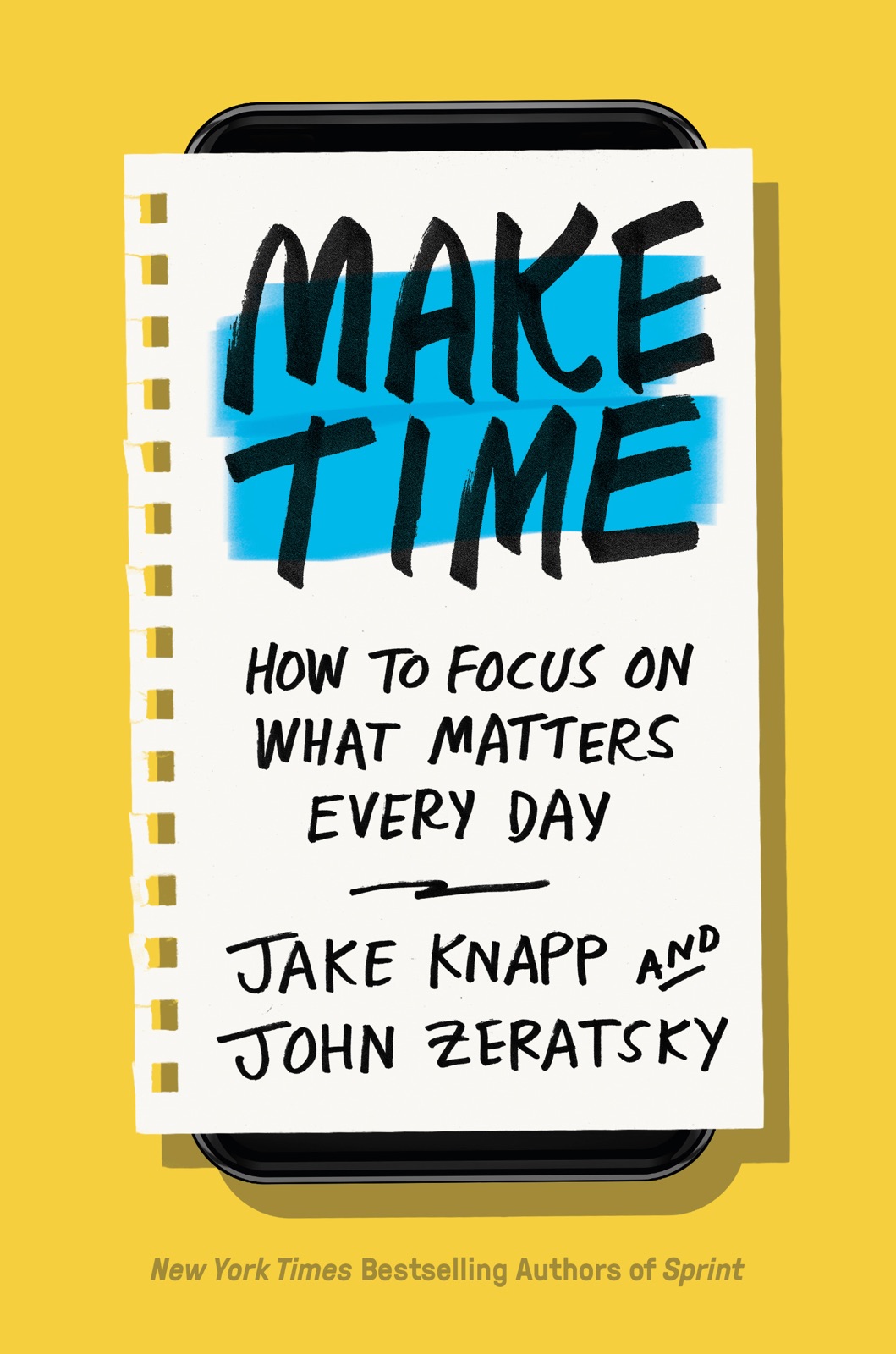
Make Time
How to Focus on What Matters Every Day
It is the rare productivity book that asks for less: one chosen highlight a day, fewer default distractions, and small experiments instead of a whole new system.
Core ideas
Choose one highlight each morning: a single 60 to 90 minute priority that becomes the centrepiece of the day, planned before email gets a vote.
Distraction is a design problem, not a willpower problem. Remove the infinity pools, the apps with no bottom, and focus stops being a daily fight.
Energy is part of the system: daily movement, real food, deliberately timed caffeine and proper sleep are what make the highlight possible.
Run your days like experiments. Try one tactic at a time, note what happened each evening, and keep only what fits your actual life.
Lessons from the book
Give the day a highlight
A day with one chosen priority beats a day of forty reactions.
Knapp and Zeratsky's core move is embarrassingly simple. Each morning, ask: if today were over and I felt good about it, what would I have done? The answer, something that takes 60 to 90 minutes, becomes the day's highlight. It might be urgent work, a project you keep postponing, or something joyful like cooking for friends. You still answer email and attend the meetings. The difference is that the day now has a centrepiece you chose, instead of being a pile of other people's requests.
The authors are explicit that this is not about doing more. A highlight is a bet on satisfaction, not volume. They offer three lenses for choosing one: urgency (what must happen today), satisfaction (what you most want to finish) and joy (what you will be glad you did). Then you protect it like a meeting with your boss: block the time in the calendar, take the morning slot if you can, and treat everything else as the background noise it usually is.
Drain the infinity pools
Apps with no bottom take attention without asking twice.
The book's name for endless feeds is infinity pools: any app you can pull to refresh forever. Email, news, social feeds and streaming all qualify. Knapp famously removed every one of them from his iPhone and kept it that way for years. The tactic is not abstinence but friction: log out after each use, delete an app and reinstall it when you truly need it, hide the browser, try a greyscale screen. Each step adds a few seconds of effort, and those seconds are usually enough for the urge to pass.
What makes this section persuasive is that both authors helped build the attention economy: Zeratsky worked on YouTube and Knapp on Gmail. They describe the defaults as deliberately engineered for engagement, then walk through resetting them one at a time: notifications off unless a human needs you, a home screen with no apps, a morning without news. None of it requires discipline in the moment. The work happens once, when you change the default, which is exactly why it holds.
Energise like it matters
Focus is a body budget before it is a mind trick.
The least fashionable third of the book argues that attention runs on physical energy. The prescriptions are modest and specific: move for about 20 minutes most days (a walk counts), eat food that will not crash you mid-afternoon, and use caffeine with timing in mind, after the morning grogginess lifts and never late enough to touch sleep. The authors treat these as focus tactics rather than health advice. A tired brain reaches for the infinity pools; a rested one can actually hold a highlight.
The same experimental frame applies here as everywhere in the book. You do not adopt the whole list; you test one change for a few days and watch what it does to your highlight. The book closes with a simple evening note: what did I try, how was my energy, what will I keep? That tiny loop is the real system. It turns productivity from a belief you hold into data you collect about your own life.
Our take
We rate Make Time as the friendliest starting point on the productivity shelf. Knapp and Zeratsky spent years running design sprints at Google Ventures, and it shows: the book is a menu of 87 small tactics rather than one rigid method, and the daily highlight habit alone repays the cover price. It is light, funny and genuinely easy to start tomorrow.
Be sceptical of the breadth, though. Plenty of the 87 tactics are obvious (drink water, go for a walk), some contradict each other by design, and readers who already guard their calendar and phone will find little new here. It is also very much a book by two former tech insiders about escaping tech defaults; if your real distraction problem is meetings and a demanding manager, Deep Work speaks to that world far better.
Is it for you?
Read it if
You want an easy, forgiving way to reclaim focus and see results this week, without rebuilding your whole routine.
Skip it if
If you already run a guarded calendar, a quiet phone and a deep work habit, most of these tactics will read as things you do.